

World's Most Popular Cuisines Ranked Infographic
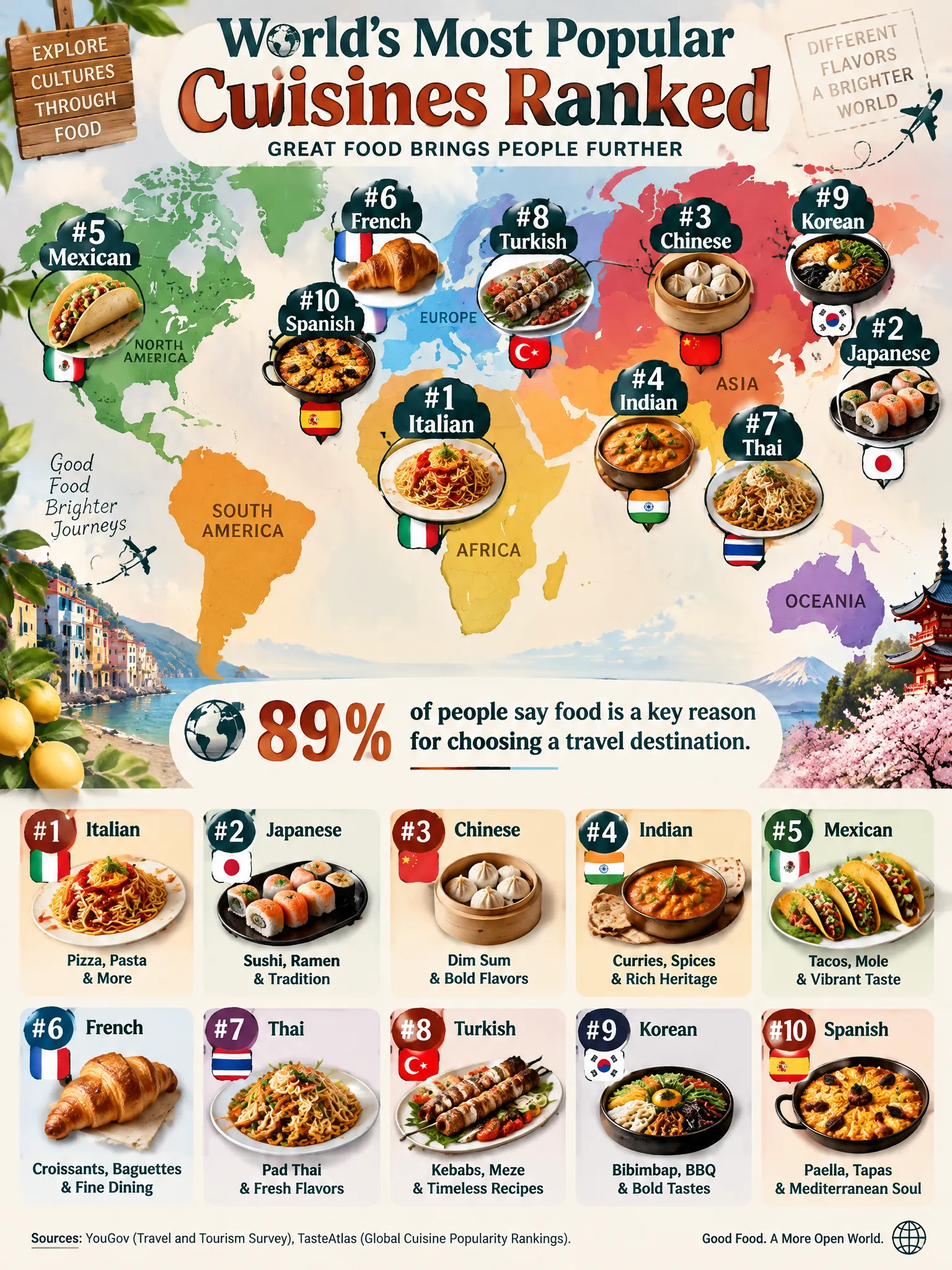
Global cuisine rankings: Italian #1 in surveys, pizza a ~$150B industry, 800K+ Chinese restaurants abroad, and food drives 89% of travel choices.
Published
Generate a custom version of this infographic
Customize with your own data, style, and branding
Generate This InfographicKey Comparisons
Comparing World's Most Popular Cuisines Ranked
Food is one of humanity's most universal languages, and culinary traditions serve as cultural ambassadors that transcend borders. Global surveys consistently reveal which cuisines captivate taste buds worldwide, though rankings shift as travel, migration, and social media expose people to new flavors. Multiple large-scale studies — including YouGov's international food survey covering 25 countries and TasteAtlas's annual cuisine rankings — converge on a remarkably consistent top tier.
Italian cuisine consistently claims the top position in global popularity polls. Its appeal lies in the simplicity of high-quality ingredients — tomatoes, olive oil, fresh herbs, aged cheeses — combined into dishes that feel both comforting and sophisticated. Pizza alone is estimated to be a $150 billion global industry. Beyond pizza and pasta, regional specialties like Neapolitan seafood, Tuscan ribollita, and Sicilian arancini demonstrate extraordinary diversity within a single culinary tradition.
Japanese cuisine ranks second in most global surveys, celebrated for its precision, presentation, and health benefits. The Japanese concept of umami — the fifth taste — has fundamentally influenced modern gastronomy worldwide. Sushi has become one of the most recognized foods globally, but Japanese culinary depth extends to ramen, tempura, kaiseki multi-course meals, and wagyu beef. Japan has more Michelin-starred restaurants than any other country, reflecting both technical excellence and deep culinary heritage.
Chinese cuisine's global reach is unmatched in terms of diaspora restaurants — there are an estimated 800,000 Chinese restaurants operating outside China. The cuisine encompasses eight major regional traditions (Sichuan, Cantonese, Shandong, Jiangsu, Zhejiang, Fujian, Hunan, and Anhui), each with distinct flavor profiles. Sichuan's mala (numbing-spicy) sensation and Cantonese dim sum culture have particularly captured international attention in recent years.
Indian cuisine ranks fourth, powered by its extraordinary spice complexity and the world's largest vegetarian cooking tradition. India uses over 40 different spices in its regional cuisines. The global market for Indian food is growing at 15 percent annually, driven by dishes like butter chicken, biryani, and dosa that have become mainstream in Western markets. Street food culture — from chaat to vada pav — is gaining recognition through food tourism and social media.
Mexican cuisine, recognized by UNESCO as an Intangible Cultural Heritage, rounds out the top five. Its foundation — corn, beans, and chili peppers — has sustained civilizations for millennia. The global taco market alone is valued at over $20 billion. Beyond tacos and burritos, authentic Mexican cuisine includes complex mole sauces requiring 20+ ingredients, fresh ceviches, and pre-Hispanic ingredients like huitlacoche and chapulines. French, Thai, Turkish, Korean, and Spanish cuisines complete most top-ten lists, each bringing distinctive techniques and flavors that continue to influence global gastronomy.
Rankings differ by methodology, which is why Italian food often leads popularity polls while Chinese cuisine wins on restaurant count. Survey-based lists like YouGov’s cross-country samples measure affection and familiarity, whereas diaspora footprint metrics highlight how many people encounter a cuisine through local takeout and street stalls. Both lenses matter: comfort and recognition drive Italian and Japanese placement, while scale and regional diversity explain Chinese and Indian persistence in the top tier.
Flavor architecture explains why certain traditions travel well. Italian builds on olive oil, tomato, and cheese combinations that adapt to global supply chains; Japanese emphasizes umami, freshness, and presentation that translate to premium dining; Mexican centers on corn, beans, and chiles with UNESCO recognition of living heritage; Thai and Korean add bold spice and fermentation profiles amplified by social media and food tourism, where a large majority of international travelers say cuisine influences destination choice.
Fusion and migration continuously reshuffle the list. Korean growth tied to cultural exports, Peruvian Nikkei visibility, and Middle Eastern staples entering Western grocery aisles show that popularity is dynamic rather than fixed. Michelin concentration in Japan signals fine-dining esteem, while the roughly $150 billion global pizza industry shows mass-market reach—two different measures of influence.
Home cooking versus restaurant experience also skews rankings. Indian vegetarian depth and spice complexity shine in household kitchens across South Asia, yet Western rankings may underweight cuisines less represented in franchise formats. Readers comparing nations should note whether a rank reflects taste surveys, economic output, or culinary diversity within borders.
Frequently Asked Questions
What is the most popular cuisine in the world?
Which country has the most diverse food culture?
How does food tourism impact global cuisine rankings?
What cuisines are growing fastest in global popularity?
Sources
- YouGov International Food Survey, 2024
- TasteAtlas Annual Cuisine Rankings, 2025
- World Food Travel Association, Food Travel Monitor, 2024
- Statista, Global Food & Beverage Market Reports, 2025
- UNESCO Intangible Cultural Heritage List
Source links go to each publisher's official website.
Embed This Infographic
Copy the code below to share this infographic on your website
<a href="https://www.makeinfographics.ai/infographic/worlds-most-popular-cuisines-ranked" target="_blank" rel="noopener">
  <img src="https://pic-cdn.chibistyle.app/infographics/infographics/world-popular-cuisines.webp"
       alt="World's Most Popular Cuisines Ranked — Global cuisine rankings: Italian #1 in surveys, pizza a ~$150B industry, 800K+ Chinese restaurants a"
       width="960" height="1280" loading="lazy"
       style="max-width:100%;height:auto;" />
</a>
<p>Source: <a href="https://www.makeinfographics.ai">MakeInfographics.ai</a> — Free AI Infographic Generator</p>
Create Your Own World's Most Popular Cuisines Ranked Infographic
Customize this topic with your own data, style, and branding
Create Custom Version — FreeMake Something for Your Own Life
Free printable planners, blank or filled in by AI from your details.

Related Infographics
All Food & Cuisine infographics →World Street Food Guide by Country
Street food is a $148B market feeding 2.5B people daily. Regional prices, jobs, safety, and iconic dishes across Asia, Latin America, and Africa.
Major Food Allergens & Label Reading Checklist 2026
Nine FDA major allergens (sesame 2023) and 14 EU Annex II allergens: Contains labels, may contain warnings, cross-contact, epinephrine.
Global Food Safety Standards Overview 2026
Unsafe food causes 600M illnesses and 420,000 deaths yearly worldwide. HACCP, recalls, cold chain tech, and global food safety standards in 2026.
Global Fermented Food Market Statistics & Gut Health Trends 2026
Fermented food data: $980B market, gut microbiome research, kimchi and kombucha growth, probiotic supplements market, and consumer adoption trends.