

Major Food Allergens & Label Reading Checklist 2026 Infographic
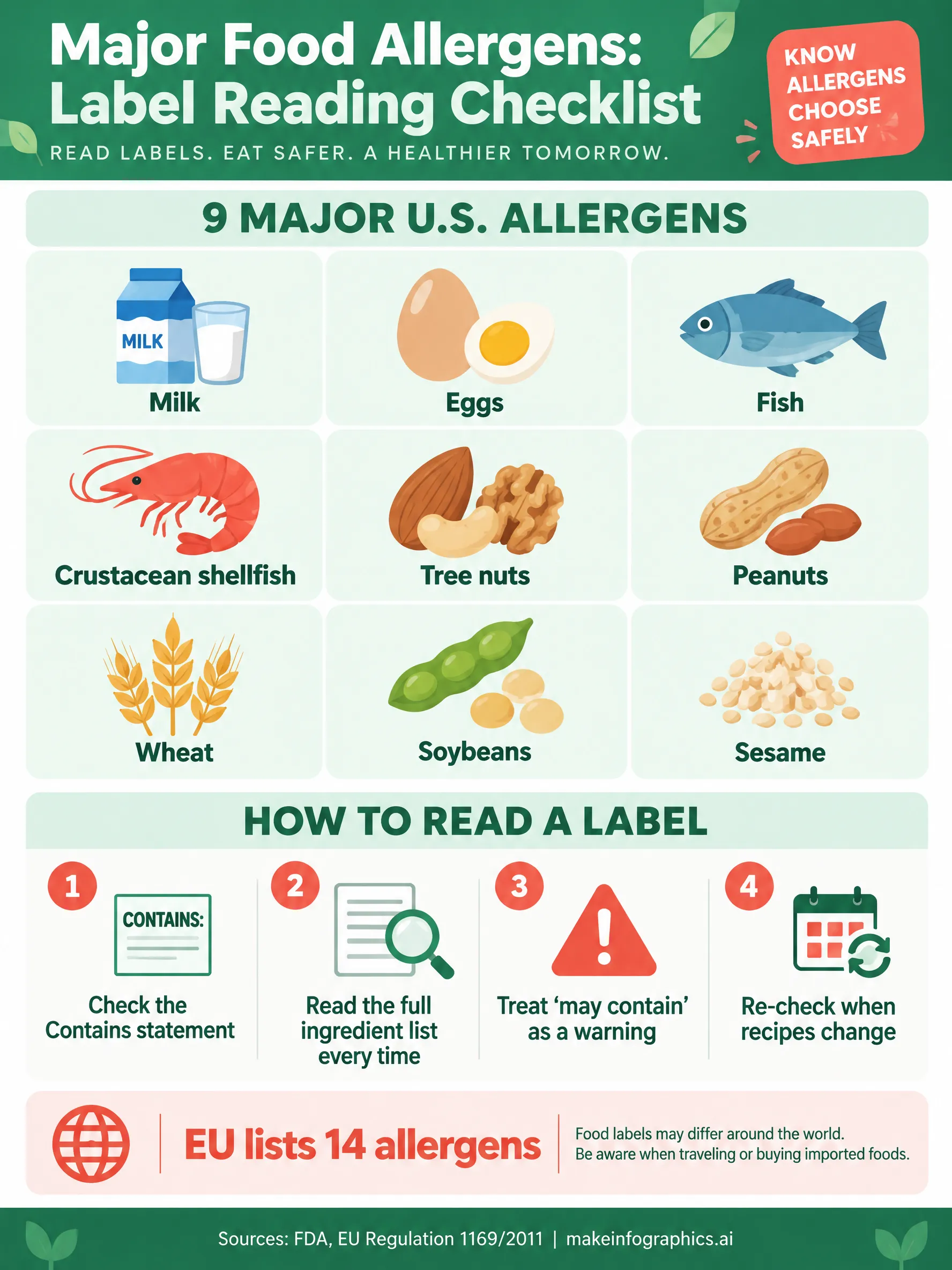
Nine FDA major allergens (sesame 2023) and 14 EU Annex II allergens: Contains labels, may contain warnings, cross-contact, epinephrine.
Published
Generate a custom version of this infographic
Customize with your own data, style, and branding
Generate This InfographicAction Items
Essential Major Food Allergens & Label Reading Checklist 2026
Food allergy management starts with knowing which proteins your law treats as priority allergens and how packaging must disclose them. In the United States, the Food and Drug Administration applies Congress’s statutory list of major food allergens to most packaged foods under its jurisdiction. The Food Allergen Labeling and Consumer Protection Act of 2004 originally named eight groups—milk, eggs, fish, crustacean shellfish, tree nuts, peanuts, wheat, and soybeans. The Food Allergy Safety, Treatment, Education, and Research (FASTER) Act, signed April 23, 2021, added sesame; labeling rules for sesame as a major allergen took effect January 1, 2023. FDA notes that products already in interstate commerce before that date did not have to be relabeled, so sesame may still be missing from some older stock.
Reading a US label is a two-track exercise. Track one is intentional ingredients. Section 403(w) of the Federal Food, Drug, and Cosmetic Act requires the food source of each major allergen to appear either in the ingredient list (often in parentheses after a technical name) or in a "Contains" statement placed immediately after or adjacent to the ingredient list. If a "Contains" line is used, it must name every major allergen in the product, not only those hidden in unfamiliar ingredient names. Track two is unintentional presence. Allergens that enter a food through cross-contact—shared equipment, carry-over, or dust—are not required to appear in the ingredient list or "Contains" line. Manufacturers may instead use voluntary advisory wording such as "may contain" or "produced in a facility that also uses" allergens. FDA treats those statements as optional, truthfulness-bound warnings, not substitutes for allergen preventive controls.
The European Union follows a broader mandatory list. Regulation (EU) No 1169/2011 Annex II requires declaration of 14 categories: gluten-containing cereals; crustaceans; eggs; fish; peanuts; soybeans; milk (including lactose); specified tree nuts; celery; mustard; sesame; sulphur dioxide and sulphites above 10 mg/kg or 10 mg/litre total SO2; lupin; and molluscs. On prepacked foods, allergens must appear in the ingredient list with emphasis (font, style, or background) that distinguishes them from other text. When there is no ingredient list, the label must say "contains" followed by the Annex II name. Travelers and importers should not assume US and EU lists match: EU covers celery, mustard, lupin, and molluscs that US law does not treat as major allergens, while US sesame rules align with EU sesame labeling but tree-nut naming and fish species rules differ in detail.
Beyond the nine majors, FDA’s allergen guidance notes that more than 160 other foods have been reported to cause allergic reactions in the United States, yet packaged labels need not use the FALCPA-style "Contains" format for those foods. That gap is why ingredient literacy still matters—mustard powder, lupin flour, or mollusc-derived ingredients may be legal and unemphasized on US labels even when they would be highlighted in the EU.
Cross-contact situations—buffets, bakeries, shared fryers, airline meals, or school cafeterias—demand a risk hierarchy separate from label reading. When a major allergen is deliberately in a recipe, avoidance is the primary strategy endorsed by public health agencies; there is no cure for food allergy. When only advisory "may contain" language appears, clinicians often help families decide whether to avoid, seek more information from the manufacturer, or accept a level of uncertainty; FDA does not standardize those phrases. Restaurant and deli foods may lack full ingredient lists, so asking about oils, garnishes, and prep surfaces is essential.
Emergency planning belongs in the same checklist as shopping. FDA emphasizes that even mild initial symptoms can progress to anaphylaxis, a severe reaction that can include airway constriction and shock. CDC school guidance identifies epinephrine as the recommended treatment for anaphylaxis and advises calling emergency medical services immediately after using an auto-injector. Antihistamines may ease hives or itching but do not replace epinephrine for breathing difficulty, throat swelling, repeated vomiting, dizziness, or multi-system symptoms. Personal action plans, prescribed auto-injectors, and follow-up care should come from your clinician; this overview is not medical advice.
Use the paired checklist in this infographic when comparing US and EU shopping, auditing pantry items after the sesame transition, or training caregivers: verify statutory allergens, scan both ingredient and "Contains" blocks, treat advisories as voluntary cross-contact signals, and separate label certainty from kitchen and dining risk.
Frequently Asked Questions
What are the nine major food allergens in the United States?
How is a US "Contains" statement different from "may contain"?
Which allergens must appear on EU prepacked food labels?
Why can the same product look different in the US and EU?
When should epinephrine be used for a food allergy reaction?
Sources
- FDA, Food Allergies and FASTER Act Overview, 2024
- FDA, Guidance for Industry: Food Allergen Labeling, Edition 5, 2025
- European Union, Regulation (EU) No 1169/2011 on Food Information to Consumers, 2025
- CDC, NCHS Data Brief 545: Diagnosed Allergic Conditions in Adults, 2026
- CDC, Food Allergies in Schools, 2024
Source links go to each publisher's official website.
Embed This Infographic
Copy the code below to share this infographic on your website
<a href="https://www.makeinfographics.ai/infographic/major-food-allergens-label-reading-checklist-2026" target="_blank" rel="noopener">
  <img src="https://pic-cdn.chibistyle.app/infographics/infographics/food-allergens-label-checklist.webp"
       alt="Major Food Allergens & Label Reading Checklist 2026 — Nine FDA major allergens (sesame 2023) and 14 EU Annex II allergens: Contains labels, may contain wa"
       width="960" height="1280" loading="lazy"
       style="max-width:100%;height:auto;" />
</a>
<p>Source: <a href="https://www.makeinfographics.ai">MakeInfographics.ai</a> — Free AI Infographic Generator</p>
Create Your Own Major Food Allergens & Label Reading Checklist 2026 Infographic
Customize this topic with your own data, style, and branding
Create Custom Version — FreeRelated Infographics
All Food & Cuisine infographics →Global Organic Food Market & Certification Checklist
Global organic food sales reached $275 billion in 2026 at 12% growth. Certification paths, labeling rules, and regional market shares explained.
Global Food Waste: Statistics & Reduction Strategies
1.3B tons of food wasted yearly — one-third of production — with 3.3B tons CO2e impact; US $408B loss, and proven supply-chain fixes.
Mediterranean Diet Health Benefits & Evidence
PREDIMED found 30% fewer cardiovascular events; large meta-analyses link Mediterranean eating to lower mortality and diabetes risk with daily targets.
Global Food Safety Standards Overview 2026
Unsafe food causes 600M illnesses and 420,000 deaths yearly worldwide. HACCP, recalls, cold chain tech, and global food safety standards in 2026.