

Most Visited Countries in the World 2026 Infographic
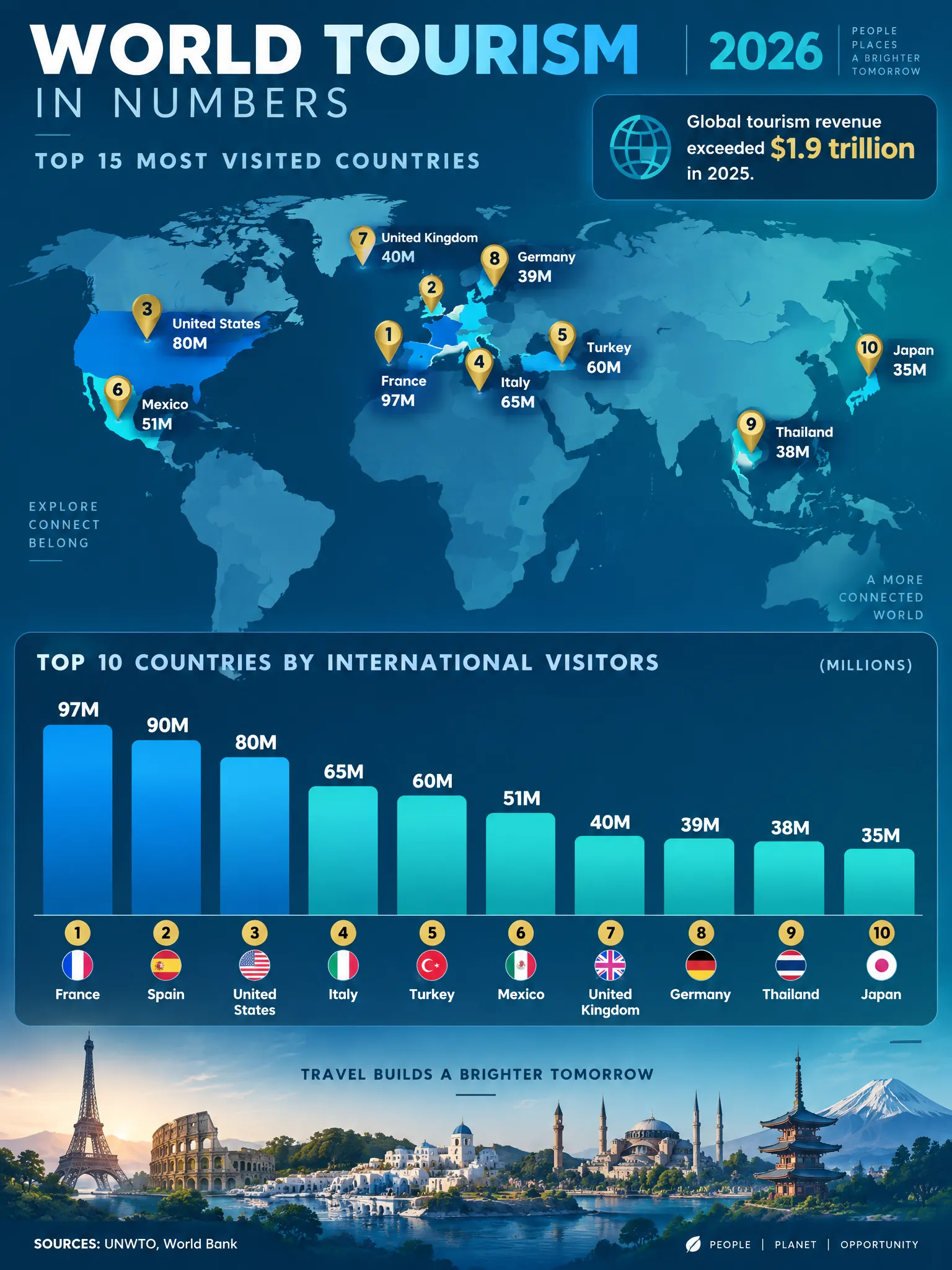
1.5B international arrivals in 2025: France ~97M visitors leads, Spain and the US follow; revenue leaders, overtourism, and regional growth.
Published
Generate a custom version of this infographic
Customize with your own data, style, and branding
Generate This InfographicKey Statistics
- 1International tourist arrivals reached 1.5 billion in 2025, surpassing the pre-pandemic record (UNWTO, 2026)
- 2Global tourism revenue exceeded $1.9 trillion in 2025 (UNWTO, 2026)
- 3France leads with ~97 million international visitors annually (French Tourism Board, 2025)
- 4The US generates over $250 billion in annual tourism revenue — the highest globally (US Travel Association, 2025)
- 5Italy has 59 UNESCO World Heritage Sites, more than any other country (UNESCO, 2025)
- 6Tourism supports approximately 1 in 10 jobs worldwide — over 330 million people (WTTC, 2025)
- 7Japan saw a 40% year-over-year increase in visitors driven by yen weakness (JNTO, 2025)
About Most Visited Countries in the World 2026
International tourism has not only recovered from the pandemic disruption but surged to record levels in 2025 and 2026. According to the United Nations World Tourism Organization (UNWTO), international tourist arrivals reached 1.5 billion in 2025, surpassing the pre-pandemic peak of 1.47 billion set in 2019. Global tourism revenue exceeded $1.9 trillion, with the sector contributing approximately 10 percent of global GDP and supporting one in ten jobs worldwide.
France maintains its position as the world's most visited country, welcoming approximately 97 million international tourists in 2025. Paris alone accounts for roughly a third of these arrivals, with the Eiffel Tower, Louvre Museum, and Palace of Versailles drawing millions annually. However, France's tourism leadership extends well beyond its capital — the French Riviera, Loire Valley wine regions, and Alpine ski resorts each attract distinct visitor segments throughout the year.
Spain ranks second with approximately 90 million visitors, powered by its Mediterranean coastlines, rich cultural heritage, and favorable climate. Barcelona, Madrid, and the Balearic Islands serve as primary tourist magnets. Spain has invested heavily in sustainable tourism infrastructure, including high-speed rail connections between major cities that make multi-destination travel seamless.
The United States holds the third position by arrivals (roughly 80 million) but leads the world in tourism revenue, generating over $250 billion annually from international visitors. New York City, Orlando, Las Vegas, and Los Angeles are the top entry points. The weak-dollar periods in recent years have made the US particularly attractive to European and Asian travelers.
Italy rounds out the top four with approximately 65 million visitors, drawn by its unmatched concentration of UNESCO World Heritage Sites (59 — the most of any country), Renaissance art, and culinary tourism. Rome, Venice, and Florence remain iconic destinations, but overtourism concerns have prompted innovative crowd management strategies including reservation systems for popular sites.
Turkey has emerged as the fastest-growing major destination, climbing to fifth place with 60 million visitors. Istanbul's position bridging Europe and Asia, the Mediterranean coast's resort infrastructure, and competitive pricing compared to Western European alternatives have driven its ascent. Southeast Asian destinations — particularly Thailand (38 million), Vietnam, and Indonesia — continue their strong growth trajectories, fueled by digital nomad communities and improved aviation connectivity.
Notable trends shaping global tourism in 2026 include the rise of experiential and cultural tourism over traditional beach holidays, the growth of sustainable and regenerative travel programs, and the increasing influence of social media and AI-powered travel planning on destination choice. Japan's visitor numbers surged 40 percent year-over-year following the yen's sustained weakness, making it one of the most compelling value destinations for Western travelers.
Arrival counts alone understate how tourism stress distributes within top destinations. France’s roughly 97 million international visitors concentrate heavily in Paris and a handful of regional icons, which amplifies housing and transport pressures even when national totals look stable. Italy’s leadership in UNESCO World Heritage Sites, at 59 listings, spreads demand across cities such as Rome, Venice, and Florence, where reservation systems and visitor caps have become standard management tools rather than temporary experiments.
Revenue rankings diverge from foot-traffic rankings in instructive ways. The United States ranks third by arrivals at roughly 80 million yet generates more than about $250 billion from international visitors because per-trip spending and length of stay run higher than in many European sun-and-city markets. Spain and France compete closely on receipts, while the United Kingdom often punches above its arrival rank on luxury and city-break spending.
Regional recovery after the pandemic was uneven even as global arrivals surpassed the 2019 peak of about 1.47 billion to reach roughly 1.5 billion in 2025. Middle East gateways and European city breaks rebounded quickly, whereas some Asian destinations needed additional years to restore visa simplicity and flight capacity. WTTC estimates that tourism supports about one in ten jobs globally, over 330 million livelihoods, so slowdowns in any major source market ripple through airlines, hospitality, and informal services.
Emerging winners such as Turkey, near 60 million visitors, combine competitive pricing with improved air links. Japan’s roughly 40 percent year-over-year visitor surge tied to yen weakness shows how exchange rates can reshuffle value rankings overnight without changing cultural assets.
Frequently Asked Questions
What is the most visited country in the world in 2026?
Which country earns the most from tourism?
What are the fastest growing tourist destinations?
How has tourism recovered since the pandemic?
Sources
- United Nations World Tourism Organization (UNWTO), Tourism Barometer, 2026
- World Travel & Tourism Council (WTTC), Economic Impact Report, 2025
- US Travel Association, Travel Facts and Figures, 2025
- Japan National Tourism Organization (JNTO), Visitor Statistics, 2025
Source links go to each publisher's official website.
Embed This Infographic
Copy the code below to share this infographic on your website
<a href="https://www.makeinfographics.ai/infographic/most-visited-countries-world-tourism-2026" target="_blank" rel="noopener">
  <img src="https://pic-cdn.chibistyle.app/infographics/infographics/most-visited-countries.webp"
       alt="Most Visited Countries in the World 2026 — 1.5B international arrivals in 2025: France ~97M visitors leads, Spain and the US follow; revenue le"
       width="960" height="1280" loading="lazy"
       style="max-width:100%;height:auto;" />
</a>
<p>Source: <a href="https://www.makeinfographics.ai">MakeInfographics.ai</a> — Free AI Infographic Generator</p>
Create Your Own Most Visited Countries in the World 2026 Infographic
Customize this topic with your own data, style, and branding
Create Custom Version — FreeMake Something for Your Own Life
Free printable planners, blank or filled in by AI from your details.



Related Infographics
All Travel & Geography infographics →World's Most Spectacular National Parks
Over 4,000 national parks span 100+ countries. See the most spectacular, from Yellowstone to Patagonia, with best seasons, wildlife, and key facts.
Heritage Tourism & Cultural Travel Statistics 2026
Heritage tourism data: $750B global market, UNESCO site visitor trends, traveler motivations, and economic impact on local communities worldwide.
Medical Tourism Global Statistics 2026
Medical tourism is a $130B industry in 2026 with 20–25M cross-border patients—top destinations, procedure costs vs the US, and JCI quality standards.
Luxury Travel Market Guide 2026
Luxury travel market size, high-net-worth traveler preferences, top destinations, experiential tourism trends, and sustainable luxury travel data.