

Global Diabetes Statistics 2026: Prevalence, Costs & Regions Infographic
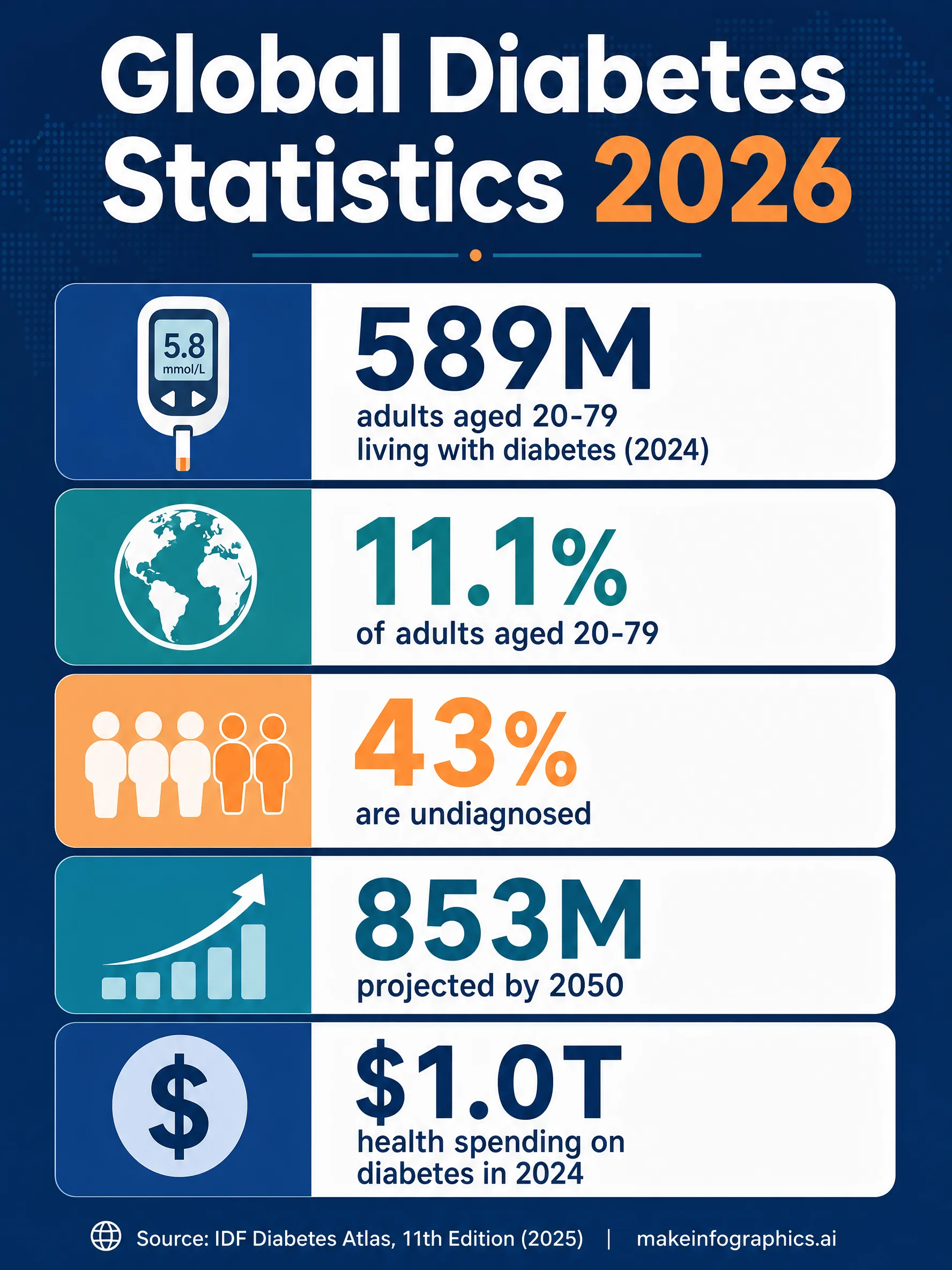
About 589 million adults had diabetes in 2024 per the IDF Diabetes Atlas 11th edition—see global prevalence, undiagnosed share, spending, and prevention.
Published
Generate a custom version of this infographic
Customize with your own data, style, and branding
Generate This InfographicKey Statistics
- 1An estimated 589 million adults aged 20–79 lived with diabetes in 2024, about 11.1% of that age group (International Diabetes Federation, IDF Diabetes Atlas, 11th edition, 2025)
- 2IDF projects about 853 million adults with diabetes worldwide by 2050 (International Diabetes Federation, IDF Diabetes Atlas, 11th edition, 2025)
- 342.8% of adults with diabetes were undiagnosed in 2024, equal to 251.7 million people (International Diabetes Federation, IDF Diabetes Atlas, 11th edition, 2025)
- 4Global diabetes-related health expenditure reached USD 1,015 billion in 2024, about 11.9% of total health spending (International Diabetes Federation, IDF Diabetes Atlas, 11th edition, 2025)
- 5The Middle East and North Africa IDF region had the highest age-standardised diabetes prevalence at 19.9% in 2024 (International Diabetes Federation, IDF Diabetes Atlas, 11th edition, 2025)
- 6More than 95% of people with diabetes have type 2 diabetes (World Health Organization, Diabetes Fact Sheet, 2024)
- 7An estimated 9.15 million people worldwide had diagnosed type 1 diabetes in 2024 (International Diabetes Federation, IDF Diabetes Atlas, 11th edition, 2025)
About Global Diabetes Statistics 2026: Prevalence, Costs & Regions
The International Diabetes Federation published the 11th edition of its Diabetes Atlas in 2025, and as of late 2026 it remains the newest global benchmark; the 12th edition is planned for 2027. That report estimates diabetes among adults aged 20 to 79, including both diagnosed and undiagnosed cases, using hundreds of national studies and careful extrapolation where local data are thin. For anyone trying to understand why diabetes dominates chronic-disease agendas, the Atlas is the place to start, though it is general health information and not a substitute for medical advice from a qualified clinician.
The headline is scale. In 2024, an estimated 589 million adults in that age band were living with diabetes, equal to about 11.1 percent of the group worldwide. Demography and urbanisation push the burden upward: even if age-specific rates stayed flat, population ageing alone would swell case numbers. IDF projects roughly 853 million adults with diabetes by 2050, while the adult population itself grows more slowly. That gap explains why health ministries treat diabetes as a planning problem, not only a clinical one.
Geography reshapes the averages. After age standardisation so countries can be compared fairly, the Middle East and North Africa region shows the highest prevalence among IDF regions, at 19.9 percent in 2024, while Africa remains lowest at 5.0 percent, partly reflecting younger populations and lower obesity rates today. Pakistan leads country-level age-standardised prevalence at 31.4 percent. By head count, China, India, and the United States carry the largest numbers of adults with diabetes, because population size matters as much as rate. Urban areas concentrate cases: prevalence was about 12.7 percent in urban settings versus 8.8 percent in rural areas in 2024, and urban totals are expected to climb sharply by 2050 as migration continues.
A parallel story is invisible disease. Just over four in ten adults with diabetes, 42.8 percent, did not know they had the condition in 2024, about 252 million people. The share of undiagnosed cases reaches 72.6 percent in the Africa region and 29.1 percent in North America and the Caribbean, the lowest among regions. Low-income countries show 58.7 percent undiagnosed versus 28.9 percent in high-income countries, reflecting weaker screening and primary care capacity rather than a milder epidemic. WHO Member States have endorsed a target that 80 percent of people with diabetes should be diagnosed by 2030, which frames how much room remains for improvement.
Type 1 and type 2 diabetes follow different logic. WHO notes that more than 95 percent of people with diabetes have type 2, which is often linked to excess weight, inactivity, and genetics and can sometimes be delayed through lifestyle change. Type 1 reflects insufficient insulin production and requires lifelong insulin; causes and prevention are not established. The Atlas, using the Type 1 Diabetes Index, estimated about 9.15 million people globally with diagnosed type 1 diabetes in 2024, with most between ages 20 and 59, challenging the myth that it only affects children. Undiagnosed type 2 still dominates the hidden burden because symptoms can stay mild for years.
Economics tie the threads together. IDF puts global diabetes-related health expenditure for adults at USD 1,015 billion in 2024, the first time the total crossed one trillion dollars, equal to about 11.9 percent of global health spending. North America and the Caribbean account for the largest share of that spending in dollars, while South and Central America devote the highest share of regional health budgets to diabetes. Per-person spending varies more than seventy-fold across IDF regions, underscoring inequity in who can access medicines, devices, and complication care.
For prevention and policy, the actionable levers are familiar but underused: population screening where health systems can absorb new cases, primary care that follows people after diagnosis, and public health measures that make healthy food and daily movement easier. WHO recommends maintaining a healthy weight, at least 150 minutes of moderate activity per week, a diet lower in sugar and saturated fat, and avoiding tobacco to delay type 2 diabetes. Individuals with risk factors should discuss testing intervals with a clinician rather than relying on symptoms alone. The Atlas numbers describe a world that already pays heavily for diabetes; the open question is whether diagnosis, treatment, and prevention scale fast enough to bend the 2050 curve.
Frequently Asked Questions
Which IDF Diabetes Atlas edition should I use in 2026?
Why are so many people with diabetes undiagnosed?
How do type 1 and type 2 diabetes differ for prevention?
Which regions face the heaviest diabetes burden?
What does diabetes cost health systems?
Sources
- International Diabetes Federation, IDF Diabetes Atlas, 11th edition, 2025
- World Health Organization, Diabetes Fact Sheet, 2024
- World Health Organization, World Diabetes Day Global Coverage Targets, 2025
Source links go to each publisher's official website.
Embed This Infographic
Copy the code below to share this infographic on your website
<a href="https://www.makeinfographics.ai/infographic/global-diabetes-statistics-idf-atlas-2026" target="_blank" rel="noopener">
  <img src="https://pic-cdn.chibistyle.app/infographics/infographics/global-diabetes-statistics-2026.webp"
       alt="Global Diabetes Statistics 2026: Prevalence, Costs & Regions — About 589 million adults had diabetes in 2024 per the IDF Diabetes Atlas 11th edition—see global pre"
       width="960" height="1280" loading="lazy"
       style="max-width:100%;height:auto;" />
</a>
<p>Source: <a href="https://www.makeinfographics.ai">MakeInfographics.ai</a> — Free AI Infographic Generator</p>
Create Your Own Global Diabetes Statistics 2026: Prevalence, Costs & Regions Infographic
Customize this topic with your own data, style, and branding
Create Custom Version — FreeRelated Infographics
All Healthcare infographics →Wearable Health Tech & Remote Patient Monitoring 2026
Wearable medical devices reached ~$72B in 2026; 60M+ US patients on RPM with fewer readmissions, FDA-cleared watches, and CGM integration trends.
Mental Health Awareness Statistics
Mental health statistics: 970 million affected globally, anxiety and depression prevalence, care access gaps, and evidence-based self-care strategies.
Sleep Cycle Stages & Sleep Health: What Happens at Night
Sleep cycle stages explained: N1, N2, deep N3, and REM, plus recommended sleep hours by age and a checklist for better sleep health.
Global Youth Mental Health Crisis 2026
Youth mental health in 2026: 250M affected globally, 42% of U.S. teens report persistent sadness, and heavy social media tied to higher depression risk.