

Mental Health Awareness Statistics Infographic
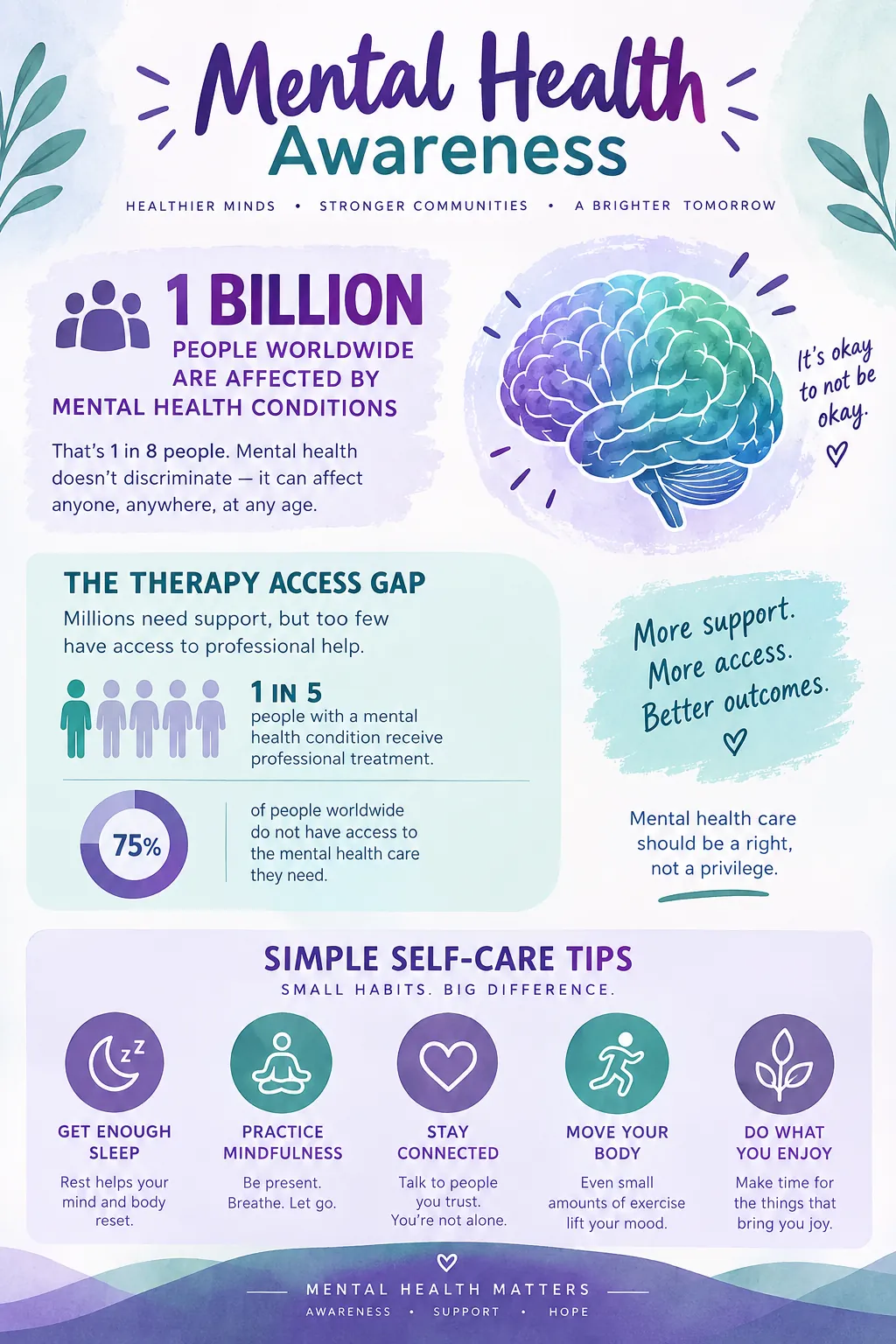
Mental health statistics: 970 million affected globally, anxiety and depression prevalence, care access gaps, and evidence-based self-care strategies.
Published
Generate a custom version of this infographic
Customize with your own data, style, and branding
Generate This InfographicKey Statistics
- 1Nearly 1 billion people worldwide live with a mental disorder (World Health Organization)
- 2Depression affects approximately 280 million people globally (WHO)
- 31 in 5 U.S. adults experiences mental illness annually; less than half receive treatment (NIMH)
- 4Mental health conditions cost the global economy $1 trillion+ in lost productivity (WHO)
- 5Suicide is the 4th leading cause of death among people aged 15-29 (WHO)
- 6Every $1 invested in mental health treatment yields $4 in returns (WHO)
- 7Teletherapy usage increased 300%+ since 2020 (American Psychological Association)
- 887% of Americans agree mental health is as important as physical health (APA Stress Survey)
About Mental Health Awareness Statistics
Mental health conditions affect hundreds of millions of people worldwide, yet stigma and access barriers prevent many from receiving adequate care. The World Health Organization estimates that nearly one billion people globally live with a mental disorder, with anxiety and depression being the most common conditions. Depression affects approximately 280 million people and is a leading cause of disability worldwide
Workplace burnout has been classified as an occupational phenomenon by the WHO, affecting an estimated 77 percent of workers who report experiencing it at their current job. In the United States, one in five adults experiences mental illness each year, yet less than half receive treatment. The global economic cost of mental health conditions exceeds $1 trillion annually in lost productivity according to WHO estimates
Young people are disproportionately affected, with suicide remaining the fourth leading cause of death among 15 to 29 year-olds globally. Workplace mental health programs show measurable returns, with every dollar invested in treatment yielding $4 in improved health and productivity. Teletherapy adoption surged 300 percent since 2020, expanding access in underserved rural and low-income communities
Public awareness campaigns and celebrity advocacy have reduced stigma, with 87 percent of Americans now agreeing that mental health is as important as physical health.
Prevalence data from the World Health Organization frame mental disorders as a leading contributor to global disability, not a marginal health topic. Anxiety and depression sit at the center of that burden, affecting hundreds of millions, while suicide among adolescents and young adults remains a preventable tragedy tied to untreated conditions, stigma, and access gaps. Low- and middle-income regions often see the widest treatment deserts, with large majorities receiving no care despite need, which amplifies economic costs estimated above $1 trillion annually when productivity losses are included.
Workplace strain adds a visible layer in high-income economies, where large majorities of workers report burnout-like experiences and occupational frameworks now recognize related phenomena. Employer programs that fund treatment show returns consistent with WHO messaging that each dollar invested can yield multiple dollars in health and productivity, yet utilization stays uneven where coverage is narrow or confidentiality fears persist. Teletherapy’s growth since 2020 expanded reach for rural and mobility-limited patients, though it does not replace crisis services or every in-person evaluation. Public attitude shifts, including broad agreement that mental health parallels physical health in importance, reduce shame but do not by themselves shorten waitlists or raise reimbursement rates.
In the United States, roughly one in five adults experiences mental illness in a given year while fewer than half receive treatment, a gap NIMH data highlight repeatedly. That mismatch shows up in emergency departments, schools, and workplaces as delayed care converts manageable symptoms into crises. Insurance parity rules on paper often fail in practice when networks are thin or prior authorization delays therapy. Common misconceptions still block help-seeking, such as treating clinical depression as mere sadness or assuming self-care alone matches evidence-based therapy and medication for moderate to severe illness. Primary care integration and stepped-care models remain underused even where they could triage mild cases and fast-track severe ones. Youth-focused prevention, school-based screening, and safe messaging about suicide require careful implementation to avoid iatrogenic harm. Through the remainder of the decade, progress will likely depend on pairing awareness campaigns with measurable access metrics: time to first appointment, parity enforcement, and workforce training pipelines rather than headlines alone.
Stigma and access barriers explain why prevalence figures understate need. Many people never seek care because of cost, fear of judgment, or a shortage of nearby providers, which is why telehealth, peer support, and primary-care integration have grown quickly. Evidence-based care, including psychotherapy and medication where appropriate, helps most people who receive it, and early support in schools and workplaces reduces long-term disability. Anyone in crisis should contact local emergency services or a crisis line immediately.
Frequently Asked Questions
How common are mental health conditions globally?
Why do so many people not receive mental health treatment?
What self-care strategies support mental health?
How has teletherapy changed mental health access?
Sources
- World Health Organization (WHO) Mental Health Report, 2024
- National Institute of Mental Health (NIMH), 2024
- American Psychological Association (APA), 2024
- Mental Health America State of Mental Health Report, 2024
Source links go to each publisher's official website.
Embed This Infographic
Copy the code below to share this infographic on your website
<a href="https://www.makeinfographics.ai/infographic/mental-health-awareness" target="_blank" rel="noopener">
  <img src="https://pic-cdn.chibistyle.app/infographics/infographics/mental-health.webp"
       alt="Mental Health Awareness Statistics — Mental health statistics: 970 million affected globally, anxiety and depression prevalence, care acc"
       width="960" height="1440" loading="lazy"
       style="max-width:100%;height:auto;" />
</a>
<p>Source: <a href="https://www.makeinfographics.ai">MakeInfographics.ai</a> — Free AI Infographic Generator</p>
Create Your Own Mental Health Awareness Statistics Infographic
Customize this topic with your own data, style, and branding
Create Custom Version — FreeMake Something for Your Own Life
Free printable planners, blank or filled in by AI from your details.


Related Infographics
All Healthcare infographics →Global Youth Mental Health Crisis 2026
Youth mental health in 2026: 250M affected globally, 42% of U.S. teens report persistent sadness, and heavy social media tied to higher depression risk.
Mental Health in the Workplace Statistics 2026
Workplace mental health 2026: 76% of U.S. workers report symptoms, healthcare burnout at 62%, and $4.20 ROI per $1 on strong wellness programs.
Global Diabetes Statistics 2026: Prevalence, Costs & Regions
About 589 million adults had diabetes in 2024 per the IDF Diabetes Atlas 11th edition—see global prevalence, undiagnosed share, spending, and prevention.
Wearable Health Tech & Remote Patient Monitoring 2026
Wearable medical devices reached ~$72B in 2026; 60M+ US patients on RPM with fewer readmissions, FDA-cleared watches, and CGM integration trends.