

Global Youth Mental Health Crisis 2026 Infographic
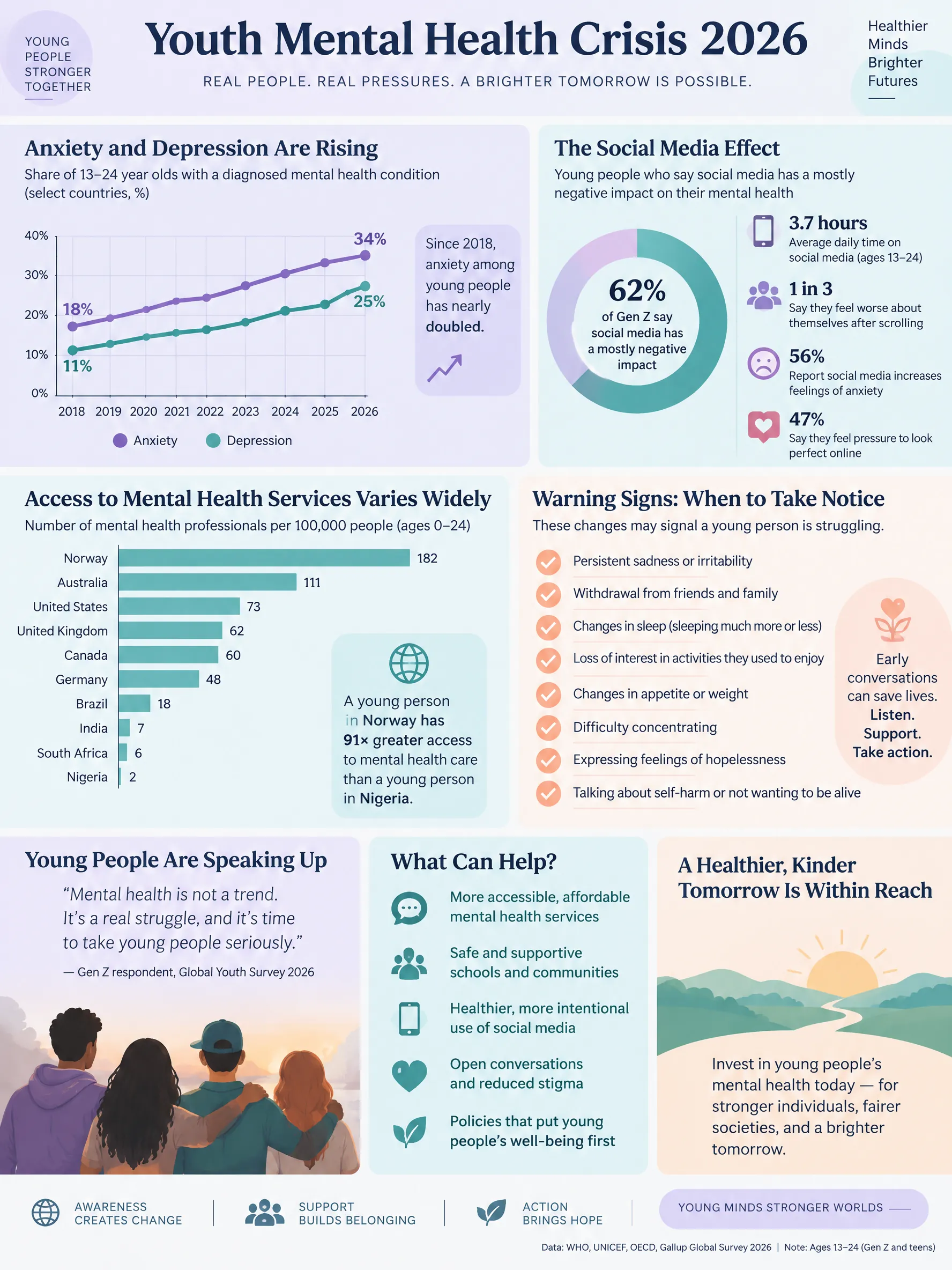
Youth mental health statistics worldwide: rising anxiety and depression rates among teens and Gen Z, social media impact, access to services, and warning signs checklist.
Published
Generate a custom version of this infographic
Customize with your own data, style, and branding
Generate This InfographicAction Items
Essential Global Youth Mental Health Crisis 2026
The youth mental health crisis has escalated to unprecedented levels globally, with the World Health Organization declaring adolescent mental health a top public health priority in 2026. Depression and anxiety rates among 10-24 year olds have doubled compared to pre-pandemic baselines, affecting an estimated 250 million young people worldwide. This checklist-style guide outlines the key data, warning signs, and actionable steps for parents, educators, and policymakers.
The statistics paint a stark picture. In the United States, 42% of high school students reported persistent feelings of sadness or hopelessness in 2025, up from 26% in 2009. Emergency department visits for mental health crises among adolescents increased 150% between 2019 and 2025. Suicide became the second leading cause of death for 15-24 year olds globally, claiming over 45,000 young lives annually. The UK's NHS reported that 1 in 5 children aged 8-16 had a probable mental health disorder in 2025. In East Asia, South Korea and Japan reported record-high youth suicide rates despite declining overall suicide trends.
Social media's role is increasingly documented. A meta-analysis of 87 studies found that heavy social media use (3+ hours daily) is associated with a 60% increase in depressive symptoms among adolescents. The mechanisms include social comparison, cyberbullying (experienced by 37% of teens globally), sleep disruption from screen time, and exposure to harmful content. However, the relationship is bidirectional — youth already experiencing mental health difficulties tend to use social media more intensively. Platforms have introduced parental controls and time limits, but enforcement remains inconsistent.
Access to mental health services reveals deep inequities. Globally, there is a severe shortage of child and adolescent mental health professionals — the ratio ranges from 1 per 500 youth in high-income countries to 1 per 100,000 in low-income nations. Average wait times for youth psychiatric care exceed 6 months in the UK and 4 months in Australia. In the US, 60% of youth with major depression do not receive any treatment. Digital mental health platforms and AI-powered screening tools are expanding access, with apps like Woebot and Headspace reporting 300% growth in youth users, though clinical evidence for app-based interventions is still accumulating.
Evidence-based prevention works when implemented at scale. School-based mental health programs that teach cognitive behavioral skills reduce anxiety and depression symptoms by 30-40%. Australia's Headspace centers — combining clinical care with vocational support — serve as a global model, now replicated in Denmark, Ireland, and Israel. Early identification through routine screening in pediatric settings catches 2-3x more cases than symptom-based referral alone. Peer support programs in universities reduce crisis episodes by 25%. Investment in youth mental health services returns $4 for every $1 spent through reduced healthcare costs, improved educational outcomes, and increased lifetime productivity.
Frequently Asked Questions
What are the warning signs of mental health issues in teens?
Does social media cause depression in young people?
What can parents do to support their child's mental health?
How can schools help address the youth mental health crisis?
Sources
- World Health Organization, Adolescent Mental Health Fact Sheet, 2026
- Centers for Disease Control and Prevention (CDC), Youth Risk Behavior Survey, 2025
- UNICEF, State of the World's Children — Mental Health, 2025
- Lancet Psychiatry, School-Based Mental Health Interventions Meta-Analysis, 2025
- Mental Health America, Access to Care Report, 2026
Source links go to each publisher's official website.
Embed This Infographic
Copy the code below to share this infographic on your website
<a href="https://www.makeinfographics.ai/infographic/global-mental-health-crisis-youth-2026" target="_blank" rel="noopener">
  <img src="https://www.makeinfographics.ai/images/infographics/youth-mental-health-crisis.webp"
       alt="Global Youth Mental Health Crisis 2026 — Youth mental health statistics worldwide: rising anxiety and depression rates among teens and Gen Z,"
       width="960" height="1280" loading="lazy"
       style="max-width:100%;height:auto;" />
</a>
<p>Source: <a href="https://www.makeinfographics.ai">MakeInfographics.ai</a> — Free AI Infographic Generator</p>
Create Your Own Global Youth Mental Health Crisis 2026 Infographic
Customize this topic with your own data, style, and branding
Create Custom Version — FreeRelated Infographics
All Healthcare infographics →Healthy Eating Habits
Science-backed nutrition guide: macronutrient balance, portion sizes, Mediterranean diet benefits, and evidence-based meal planning strategies.
Mental Health Awareness Statistics
Mental health statistics: 970 million affected globally, anxiety and depression prevalence, care access gaps, and evidence-based self-care strategies.
Telemedicine & Digital Health Statistics 2026
Comprehensive overview of telehealth adoption, remote patient monitoring, wearable health devices, and the digital transformation reshaping healthcare delivery worldwide.
Global Vaccine Development Timeline
Timeline of vaccine milestones from smallpox inoculation to mRNA breakthroughs, covering development timelines, immunization coverage, R&D investment, and future pipeline targets.