

Sleep Cycle Stages & Sleep Health: What Happens at Night Infographic
Sleep cycle stages explained: N1, N2, deep N3, and REM, plus recommended sleep hours by age and a checklist for better sleep health.
Published
Generate a custom version of this infographic
Customize with your own data, style, and branding
Generate This InfographicProcess Steps
How Sleep Cycle Stages & Sleep Health: What Happens at Night
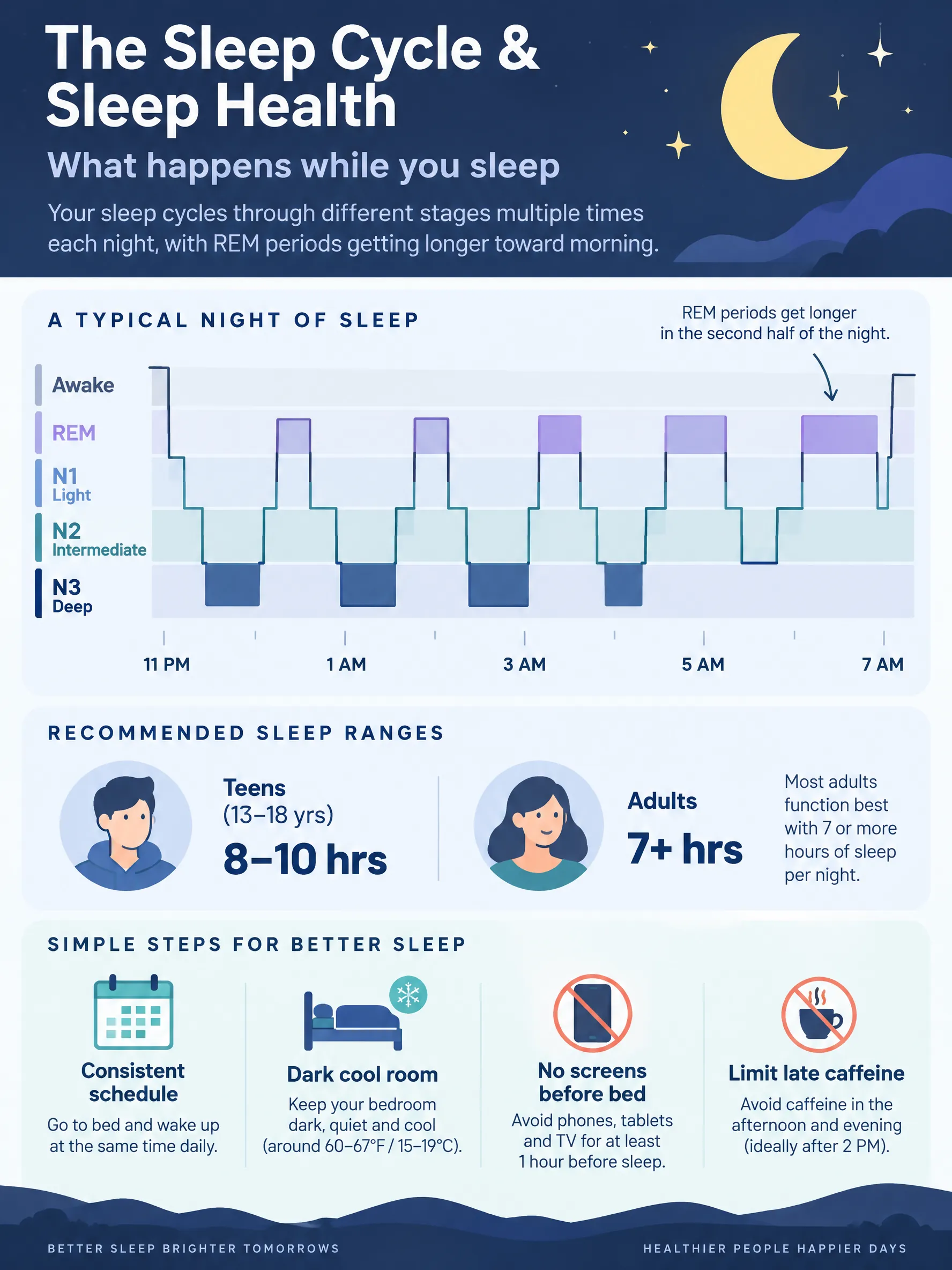
Sleep is not a single uniform state. Each night the brain moves through repeating cycles of distinct stages, each with its own pattern of brain waves, muscle tone, and body function. A complete cycle typically takes between about 70 and 120 minutes, averaging close to 90, and adults pass through several cycles in a full night. Understanding the stages makes it easier to see why both the amount and the consistency of sleep matter for health, and why a night of fragmented sleep can feel worse than its total hours suggest.
The cycle begins with stage N1, the lightest sleep. It lasts only a few minutes as heart rate and breathing slow and muscles relax. People woken in this stage often say they were not really asleep. Stage N2 follows and occupies the largest share of the night. Body temperature drops, eye movements stop, and brief bursts of brain activity called sleep spindles appear, which researchers link to memory processing and to protecting sleep from outside noise.
Stage N3, also called deep or slow-wave sleep, is the most physically restorative phase. Brain waves become slow and large, and it is hard to wake someone. Deep sleep is concentrated in the first half of the night, so it is relatively protected when sleep is cut short in the morning, while REM suffers first. Growth hormone release, tissue repair, and immune function are all associated with this stage.
REM sleep, named for rapid eye movement, is when most vivid dreaming occurs. Brain activity resembles wakefulness while the body's voluntary muscles are temporarily paralyzed. According to the National Institutes of Health's NCBI Bookshelf, REM accounts for roughly 20 to 25 percent of adult sleep, and REM periods grow longer toward morning. REM is linked with emotional processing and learning, so shortened sleep that cuts off the final cycles tends to remove REM first.
How much sleep is enough? The American Academy of Sleep Medicine and Sleep Research Society consensus recommends that adults sleep at least seven hours per night on a regular basis, and that teenagers aged 13 to 18 sleep 8 to 10 hours. Yet CDC survey data show that 30.5 percent of American adults slept fewer than seven hours on average in 2024, compared with about 35 percent in 2014, so roughly three in ten adults still fall short. Chronic short sleep is associated with higher risks of obesity, type 2 diabetes, cardiovascular disease, depression, and accidents, which is why public health agencies treat sleep as a pillar of health alongside nutrition and exercise.
Sleep disorders are another reason to pay attention. Obstructive sleep apnea, in which breathing repeatedly stops during sleep, is estimated by the American Academy of Sleep Medicine to affect nearly 30 million adults in the United States, with about 80 percent of cases undiagnosed. Loud snoring, gasping at night, morning headaches, and excessive daytime sleepiness are signals to discuss with a physician instead of simply adding more time in bed.
Timing matters as much as duration. The body's internal clock, or circadian rhythm, responds strongly to light, so irregular schedules, late-night screen use, and shift work can push sleep out of alignment even when total hours look adequate. This is why researchers increasingly talk about sleep regularity and not only sleep length. Short naps can help afternoon alertness for many people, while long naps late in the day may make it harder to fall asleep that night.
For most people, better sleep comes from habits more than devices. Keep a consistent schedule, including weekends, so the body clock stays aligned. Make the bedroom dark, quiet, and cool. Stop screens and bright light for the last hour before bed, and avoid caffeine in the late afternoon and evening, since its effects can last many hours. Limit alcohol near bedtime because it fragments the second half of the night even when it helps you fall asleep. Get morning daylight and regular exercise, but avoid very intense workouts right before bed. If problems persist for several weeks, a clinician can screen for insomnia and sleep apnea, and cognitive behavioral therapy for insomnia is widely recommended as a first-line treatment.
Frequently Asked Questions
What are the stages of sleep?
How much sleep do adults and teenagers need?
Is deep sleep or REM sleep more important?
Why do I wake up tired after eight hours in bed?
What simple habits improve sleep?
Sources
- American Academy of Sleep Medicine, Consensus Statements and Sleep Education, 2025
- Centers for Disease Control and Prevention, NCHS Data Brief 559, 2024
- National Institutes of Health, NINDS Brain Basics: Understanding Sleep, 2025
Source links go to each publisher's official website.
Embed This Infographic
Copy the code below to share this infographic on your website
<a href="https://www.makeinfographics.ai/infographic/sleep-cycle-stages-sleep-health-guide-2026" target="_blank" rel="noopener">
  <img src="https://pic-cdn.chibistyle.app/infographics/infographics/sleep-cycle-sleep-health-2026.webp"
       alt="Sleep Cycle Stages & Sleep Health: What Happens at Night — Sleep cycle stages explained: N1, N2, deep N3, and REM, plus recommended sleep hours by age and a ch"
       width="960" height="1280" loading="lazy"
       style="max-width:100%;height:auto;" />
</a>
<p>Source: <a href="https://www.makeinfographics.ai">MakeInfographics.ai</a> — Free AI Infographic Generator</p>
Create Your Own Sleep Cycle Stages & Sleep Health: What Happens at Night Infographic
Customize this topic with your own data, style, and branding
Create Custom Version — FreeRelated Infographics
All Healthcare infographics →Global Youth Mental Health Crisis 2026
Youth mental health in 2026: 250M affected globally, 42% of U.S. teens report persistent sadness, and heavy social media tied to higher depression risk.
Medical Device Innovation Milestones Timeline 2026
Medtech reached about $620B in 2026: AI device approvals, robotic surgery, CGMs, FDA pathways, and EU MDR impacts on innovation speed.
Wearable Health Tech & Remote Patient Monitoring 2026
Wearable medical devices reached ~$72B in 2026; 60M+ US patients on RPM with fewer readmissions, FDA-cleared watches, and CGM integration trends.
Mental Health in the Workplace Statistics 2026
Workplace mental health 2026: 76% of U.S. workers report symptoms, healthcare burnout at 62%, and $4.20 ROI per $1 on strong wellness programs.