

Edge Computing Infrastructure Statistics 2026 Infographic
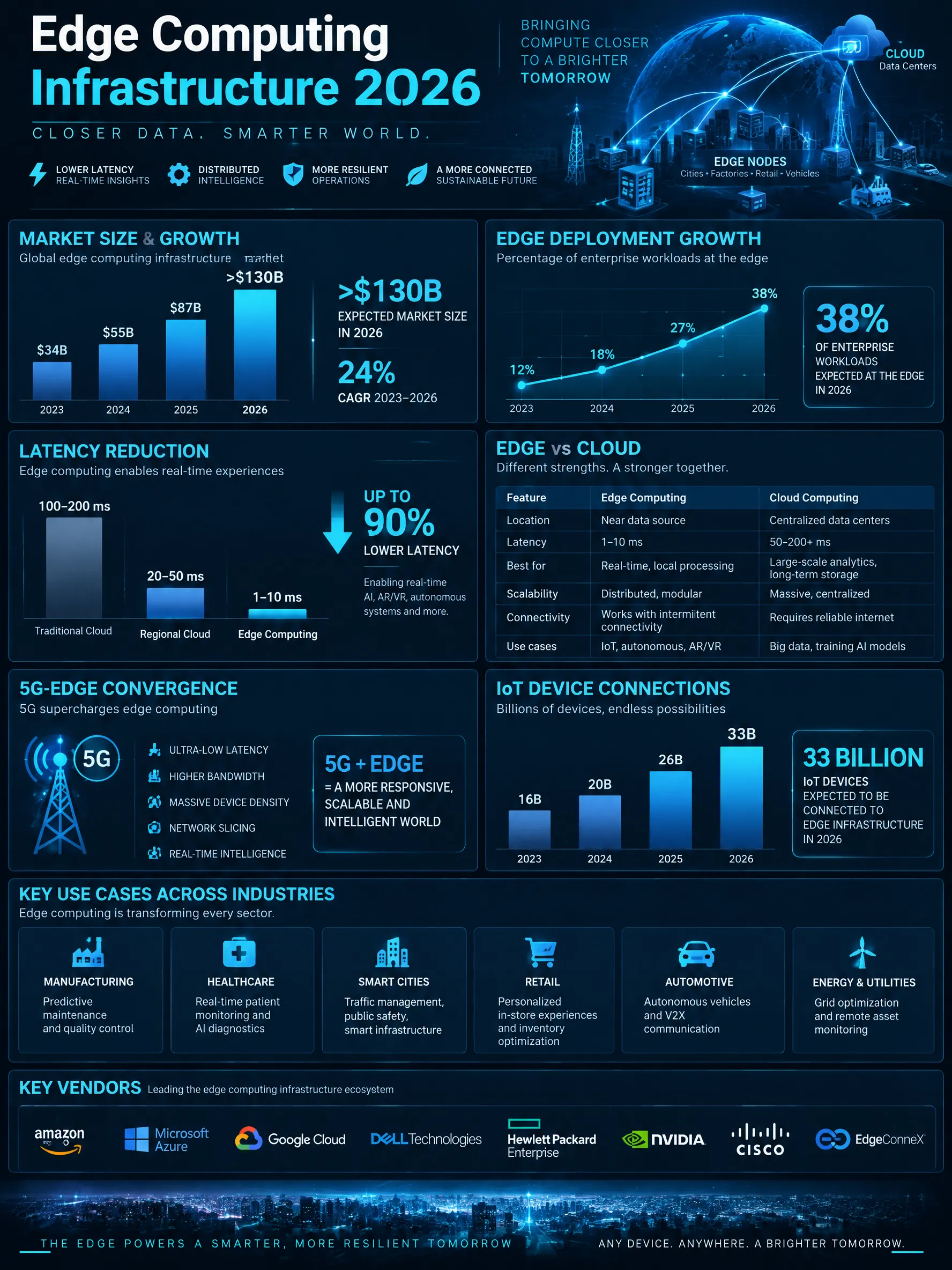
Edge computing market data for 2026: infrastructure spending exceeding $90 billion, latency benchmarks, 5G convergence, IoT deployment scale, and industry-specific use cases.
Published · Updated
Generate a custom version of this infographic
Customize with your own data, style, and branding
Generate This InfographicProcess Steps
How Edge Computing Infrastructure Statistics 2026
Edge computing has become a foundational infrastructure layer as organizations push computation closer to data sources to reduce latency, improve reliability, and comply with data sovereignty requirements. Global edge computing infrastructure spending reached $92 billion in 2026, representing 24 percent year-over-year growth as enterprises deploy micro data centers, edge servers, and intelligent gateways across thousands of locations.
The 5G-edge convergence is the primary growth catalyst. Mobile network operators have deployed over 8 million 5G small cells globally, each functioning as a potential edge computing node. Multi-access edge computing (MEC) platforms enable applications to run within 10 milliseconds of end users, compared to 50-100 milliseconds for centralized cloud. This latency reduction unlocks real-time applications in autonomous vehicles, augmented reality, industrial automation, and remote surgery that are fundamentally impossible with traditional cloud architectures.
IoT device proliferation drives edge demand. An estimated 29 billion connected devices generate over 73 zettabytes of data annually, with 60 percent of that data most efficiently processed at the edge rather than transmitted to centralized cloud facilities. Smart factories deploy 500-2,000 edge sensors per facility for predictive maintenance, quality control, and process optimization. Retailers use edge computing for real-time inventory management, dynamic pricing, and in-store customer analytics.
The competitive landscape features cloud hyperscalers (AWS Outposts, Azure Stack Edge, Google Distributed Cloud) competing with telecom operators (AT&T, Verizon, Deutsche Telekom) and specialized edge platforms (Fastly, Cloudflare Workers, Akamai). Kubernetes-based edge orchestration has emerged as the standard deployment framework, with 78 percent of edge deployments using container-based architectures. Energy efficiency remains a key challenge, with edge facilities consuming 30-40 percent more power per compute unit than centralized data centers due to smaller scale and environmental exposure.
Frequently Asked Questions
What is edge computing and why does it matter?
How big is the edge computing market in 2026?
What is the relationship between 5G and edge computing?
Sources
- IDC Worldwide Edge Spending Guide, 2026
- GSMA Intelligence, 5G Deployment Tracker, 2026
- ABI Research, Edge Computing Latency Benchmarks, 2026
- Gartner, Edge Computing Infrastructure Report, 2026
- CNCF Edge Computing Survey, 2026
- Grand View Research, Edge Computing Market Report, 2026
- IoT Analytics, Global IoT Device Forecast, 2026
Source links go to each publisher's official website.
Embed This Infographic
Copy the code below to share this infographic on your website
<a href="https://www.makeinfographics.ai/infographic/edge-computing-infrastructure-statistics-2026" target="_blank" rel="noopener">
  <img src="https://www.makeinfographics.ai/images/infographics/edge-computing-2026.webp"
       alt="Edge Computing Infrastructure Statistics 2026 — Edge computing market data for 2026: infrastructure spending exceeding $90 billion, latency benchmar"
       width="960" height="1280" loading="lazy"
       style="max-width:100%;height:auto;" />
</a>
<p>Source: <a href="https://www.makeinfographics.ai">MakeInfographics.ai</a> — Free AI Infographic Generator</p>
Create Your Own Edge Computing Infrastructure Statistics 2026 Infographic
Customize this topic with your own data, style, and branding
Create Custom Version — FreeRelated Infographics
All Technology & SaaS infographics →Artificial Intelligence Trends 2026
Explore 2026 AI trends: generative AI adoption, enterprise spending above $300B, agentic systems, and industry use cases from healthcare to finance.
Remote Work Productivity Statistics
Remote work data: 58% of knowledge workers hybrid, measurable productivity gains, $11K annual savings per remote employee, and rising satisfaction scores.
Blockchain Technology Explained
How blockchain works: distributed ledgers, consensus mechanisms, smart contracts, DeFi growth, and enterprise adoption across supply chain and finance.
Cybersecurity Best Practices
Essential cybersecurity practices: password hygiene, MFA adoption, phishing defense, encryption standards, and incident response for organizations.