

Artificial Intelligence Trends 2026 Infographic
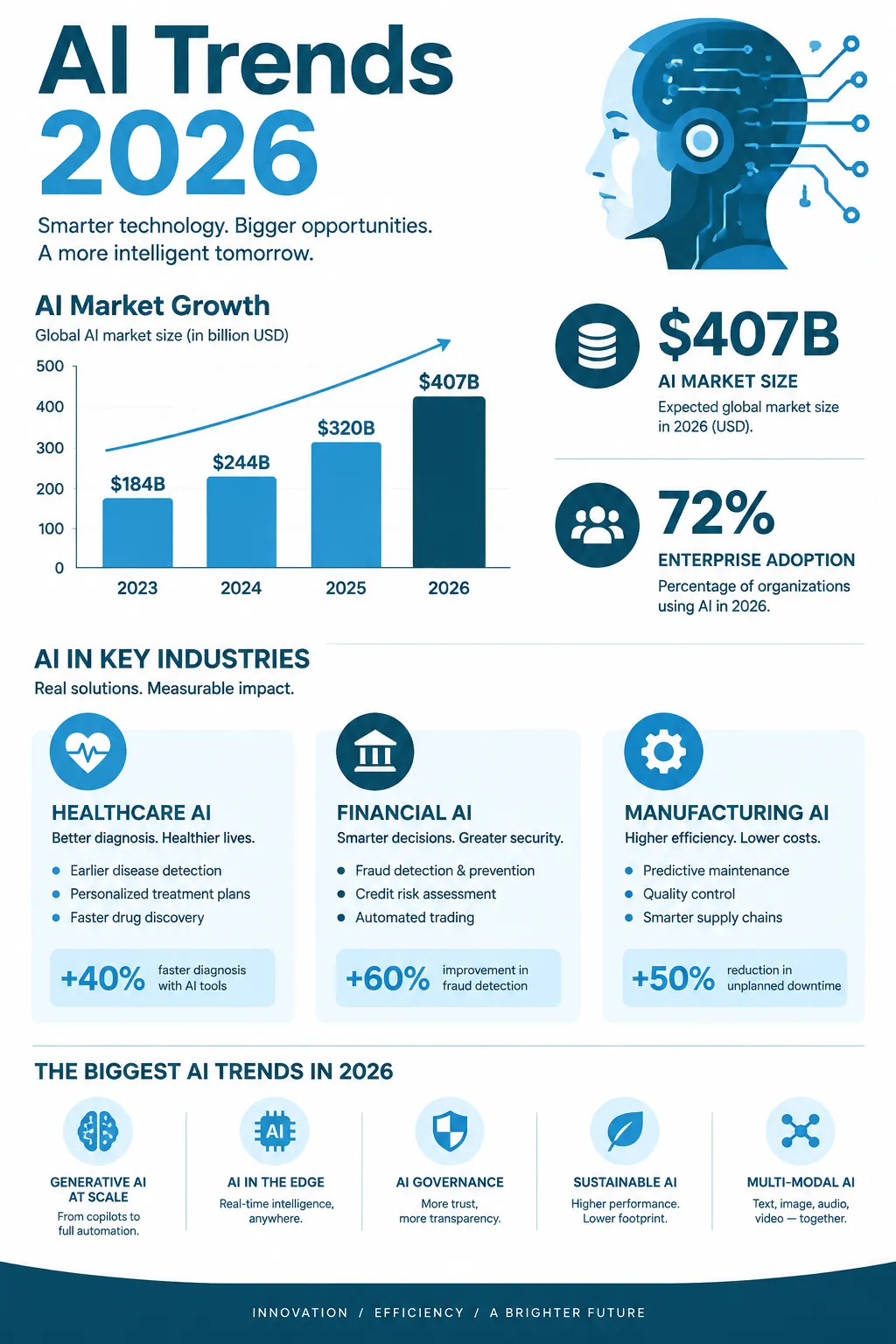
Explore 2026 AI trends: generative AI adoption, enterprise spending above $300B, agentic systems, and industry use cases from healthcare to finance.
Published
Generate a custom version of this infographic
Customize with your own data, style, and branding
Generate This InfographicKey Statistics
- 1Global AI market is projected to reach $407 billion by 2027 (Grand View Research)
- 272% of enterprises report active generative AI pilots or production deployments (McKinsey, 2025)
- 3Enterprise AI spending exceeded $150 billion globally in 2025 (IDC)
- 4AI-related job postings grew 74% year-over-year in the United States (LinkedIn Economic Graph)
- 5Healthcare AI diagnostics market expected to hit $45 billion by 2028 (MarketsandMarkets)
- 6Average ROI on mature AI deployments ranges from 15% to 25% productivity improvement (MIT Sloan)
- 7Agentic AI systems are forecast to automate 30% of routine knowledge work by 2027 (Gartner)
About Artificial Intelligence Trends 2026
Artificial intelligence has moved from experimental pilots to core business infrastructure across nearly every major industry. In 2026, enterprise AI spending continues to accelerate as organizations deploy generative models, autonomous agents, and real-time decision systems at scale. Global AI software revenue is projected to exceed $300 billion, with the largest investments concentrated in cloud infrastructure, model fine-tuning, and industry-specific applications
Healthcare leads adoption in diagnostic imaging and drug discovery, while financial services deploy AI for fraud detection and algorithmic trading. Manufacturing uses computer vision for quality control, and retail leverages personalization engines that drive measurable conversion lifts. Open-source model ecosystems have lowered barriers to entry, enabling mid-size companies to build custom applications without massive capital expenditure
Regulatory frameworks including the EU AI Act are shaping how organizations classify risk, document model decisions, and audit training data. Key challenges remain around data governance, model hallucinations, and workforce reskilling, but ROI benchmarks show that mature deployments deliver 15 to 25 percent productivity gains. Small and mid-size businesses are increasingly adopting AI-as-a-service platforms rather than building models in-house
Edge computing deployments are expanding as latency-sensitive applications move closer to data sources. Understanding these trends helps leaders prioritize investments, evaluate vendor ecosystems, and build responsible AI governance frameworks that balance innovation with compliance.
Enterprise adoption in 2026 is less about proving models work and more about integrating them with existing ERP, CRM, and data platforms without breaking governance. Roughly 72 percent of enterprises report active generative AI pilots or production use, while spending trajectories point toward software revenue above $300 billion as cloud, fine-tuning, and vertical applications absorb budget. Financial services and healthcare lead regulated sectors because fraud detection, diagnostics, and documentation savings are measurable, though each requires audit trails aligned with frameworks such as the EU AI Act.
Agentic workflows represent the next operational shift: systems that plan multi-step tasks rather than answer single prompts. Forecasts that agentic automation could handle a large share of routine knowledge work by 2027 push organizations to redesign approvals, logging, and human override points before delegating customer-facing actions. Multimodal models that combine text, image, and audio expand use cases in quality inspection, training, and support, while edge deployment grows where latency or data residency rules block pure cloud inference.
Workforce and vendor strategy determine whether gains match headline ROI ranges of 15 to 25 percent productivity on mature deployments. AI-related job postings rising sharply in the US signal competition for implementers, even as low-code and open-source ecosystems let mid-size firms experiment without building foundation models internally. Leaders should prioritize data quality, hallucination controls, and phased rollouts with human-in-the-loop review rather than betting on single-vendor lock-in, because integration debt often exceeds model licensing cost over three-year horizons.
Retail and manufacturing use cases illustrate how value accrues at the process edge. Personalization engines tied to first-party data can lift conversion when recommendations respect inventory and margin rules, while computer vision on lines catches defects earlier than manual sampling alone. Healthcare imaging and drug discovery pipelines remain capital intensive but attract spend because outcomes tie directly to revenue and reimbursement, unlike generic chat assistants whose benefit is harder to isolate in quarterly results.
Risk classification under emerging law pushes documentation into the critical path. High-risk use cases demand impact assessments, training-data provenance, and ongoing monitoring for drift or bias, which slows rollout but reduces regulatory and reputational tail risk. Smaller firms increasingly buy AI-as-a-service with standardized guardrails instead of hosting open weights, trading flexibility for faster time to compliance-ready deployment.
Capital markets still price AI as a long-cycle bet: projections toward a $407 billion market by 2027 imply sustained infrastructure spend even when individual apps fail. Executives should tie each initiative to measurable throughput, error rate, or revenue lift rather than pilot counts alone.
Frequently Asked Questions
What are the biggest AI trends in 2026?
How much are companies spending on AI in 2026?
Which industries are adopting AI fastest?
What challenges do organizations face with AI adoption?
Sources
- Grand View Research, 2025
- McKinsey Global Institute, 2025
- IDC Worldwide AI Spending Guide, 2025
- Gartner AI Hype Cycle, 2025
Source links go to each publisher's official website.
Embed This Infographic
Copy the code below to share this infographic on your website
<a href="https://www.makeinfographics.ai/infographic/artificial-intelligence-trends-2026" target="_blank" rel="noopener">
  <img src="https://pic-cdn.chibistyle.app/infographics/infographics/ai-trends-2026.webp"
       alt="Artificial Intelligence Trends 2026 — Explore 2026 AI trends: generative AI adoption, enterprise spending above $300B, agentic systems, an"
       width="960" height="1440" loading="lazy"
       style="max-width:100%;height:auto;" />
</a>
<p>Source: <a href="https://www.makeinfographics.ai">MakeInfographics.ai</a> — Free AI Infographic Generator</p>
Create Your Own Artificial Intelligence Trends 2026 Infographic
Customize this topic with your own data, style, and branding
Create Custom Version — FreeMake Something for Your Own Life
Free printable planners, blank or filled in by AI from your details.


Related Infographics
All Technology & SaaS infographics →Robotic Process Automation (RPA) Statistics & Market Trends 2026
RPA market data: $22B industry valuation, 65% enterprise adoption, bot deployment stats, cost savings metrics, and leading automation use cases.
Electric Vehicle Market Overview
EV market 2026: 17M+ global sales, China leading at 60% share, charging network expansion, battery cost declines, and manufacturer rankings.
Edge Computing Infrastructure Statistics 2026
Edge computing infrastructure spending reached $92 billion in 2026, up 24%. See latency benchmarks, 5G small-cell growth, IoT scale, and key use cases.
Autonomous Vehicle Safety Statistics 2026
Self-driving car safety data, accident rates vs human drivers, sensor technology layers, regulatory milestones, and AV deployment statistics worldwide.