

Cybersecurity Best Practices Infographic
Essential cybersecurity practices: password hygiene, MFA adoption, phishing defense, encryption standards, and incident response for organizations.
Published
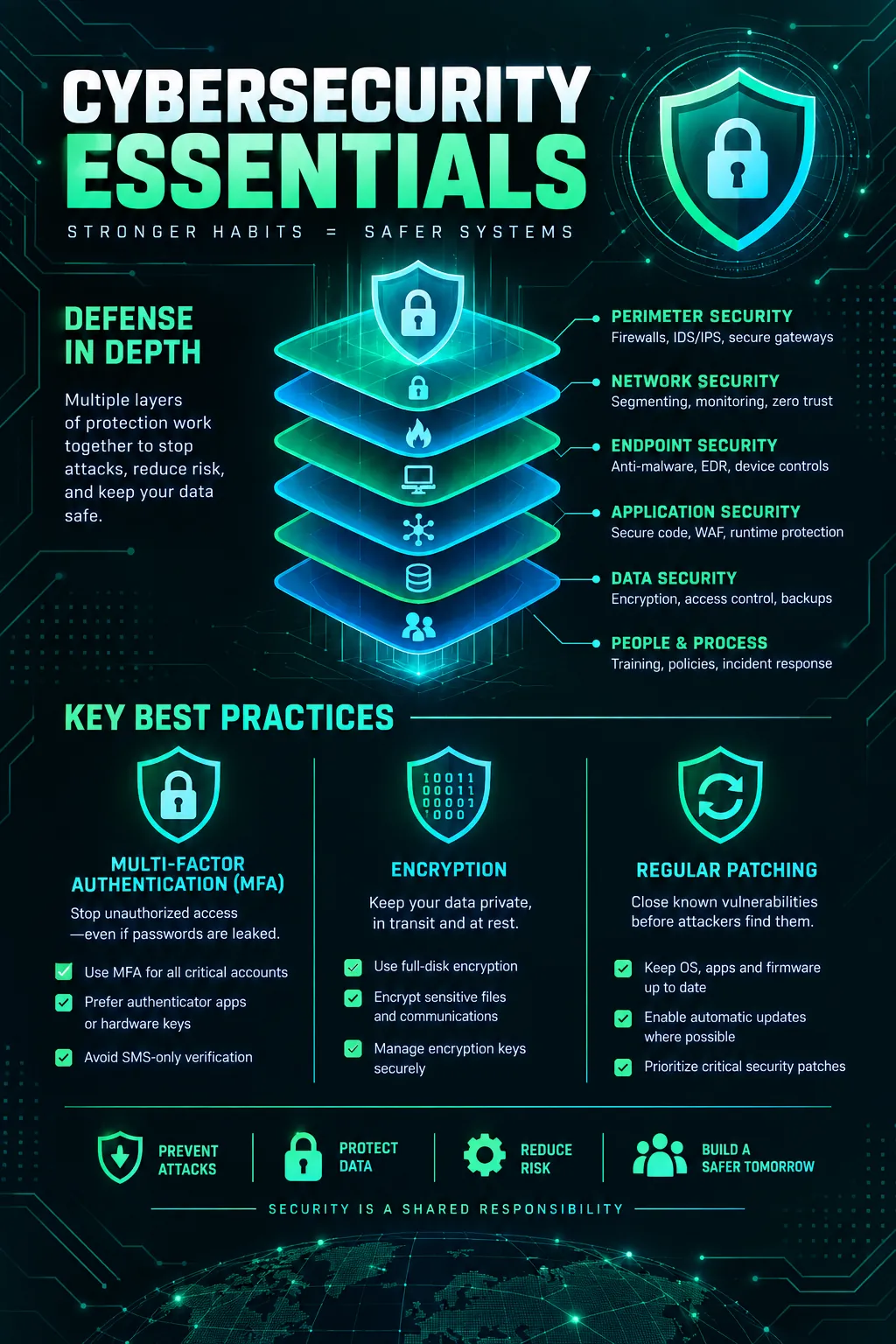
Generate a custom version of this infographic
Customize with your own data, style, and branding
Generate This InfographicAction Items
Essential Cybersecurity Best Practices
Cybersecurity has become a board-level priority as cyberattacks grow in frequency, sophistication, and financial impact worldwide. Global cybercrime damages are projected to reach $10.5 trillion annually by 2025, making it one of the largest transfer-of-wealth mechanisms in the modern economy. Human error remains the leading cause of breaches, with phishing attacks accounting for over 90 percent of successful intrusions according to industry reports
Supply chain attacks targeting third-party vendors have surged, with high-profile incidents affecting thousands of downstream organizations through a single compromised software provider. Multi-factor authentication blocks 99.9 percent of automated account compromise attempts and should be mandatory for all privileged accounts and remote access. Password managers and strong unique credentials reduce credential-stuffing success rates dramatically, yet 80 percent of breaches still involve weak or reused passwords
Data encryption at rest and in transit protects sensitive information even when perimeter defenses fail. Organizations with documented incident response plans reduce breach recovery costs by an average of $1.5 million compared to unprepared counterparts. Zero-trust architecture adoption grew 40 percent among enterprise organizations in 2024
Regular security awareness training, patch management, zero-trust network architecture, and continuous vulnerability scanning form the foundation of a resilient security posture for businesses of all sizes.
Threat models in 2026 assume attackers will chain social engineering, stolen credentials, and software supply chain weaknesses rather than rely on a single exploit. Industry estimates put global cybercrime damages on track toward $10.5 trillion annually, while phishing still underpins the vast majority of successful intrusions in major vendor reports. That pattern reinforces why technical email authentication via DMARC, SPF, and DKIM must pair with simulation training instead of annual slide decks alone.
Identity and access hygiene deliver disproportionate risk reduction relative to cost. Multi-factor authentication blocking about 99.9 percent of automated account takeover attempts addresses the reality that 80 percent of hacking-related breaches still involve weak or reused passwords. Privileged access management, just-in-time elevation, and password managers scale better than complex rotation policies users circumvent. Zero-trust adoption growth near 40 percent among enterprises reflects recognition that perimeter VPNs no longer define trust once SaaS and mobile endpoints dominate.
Resilience planning converts breaches from existential events into manageable incidents. Organizations with tested incident response plans save on the order of $1.5 million per breach compared with unprepared peers in IBM-style cost studies, while encryption at rest and in transit limits exposure when perimeter controls fail. Patch critical vulnerabilities within forty-eight hours, maintain continuous vulnerability scanning, and treat third-party software updates as production changes because single-vendor compromises can cascade across thousands of downstream customers.
Security awareness should be continuous and role-specific. Finance and HR teams face targeted business email compromise, developers face repository secret leaks, and executives face impersonation during payment approvals. Quarterly program reviews, annual penetration tests, and tabletop exercises for ransomware and data exfiltration keep playbooks current as regulations and insurance underwriters ask for evidence of operational maturity, not policy PDFs alone.
Backup and recovery deserve equal billing with prevention because ransomware volume rose sharply in recent industry threat reports. Immutable backups, segmented restore paths, and rehearsed recovery time objectives prevent ransom payments from becoming the default option when encryption hits production shares. Logging and central SIEM correlation remain essential to detect lateral movement early, especially when attackers leverage valid credentials after a successful phish.
Vendor and cloud shared responsibility models confuse accountability unless roles are written down. Map which party patches hypervisors, which rotates API keys, and which monitors SaaS admin consoles, then audit those controls on the same cadence as internal systems. Average breach costs near $4.88 million in recent global surveys make gaps in that split an executive issue, not only an IT ticket queue.
Frequently Asked Questions
What is the most important cybersecurity practice for individuals?
How can businesses prevent phishing attacks?
What is zero-trust security architecture?
How often should organizations update their security practices?
Sources
- IBM Cost of a Data Breach Report, 2024
- Verizon Data Breach Investigations Report (DBIR), 2024
- Cybersecurity Ventures Official Annual Cybercrime Report, 2024
- National Institute of Standards and Technology (NIST), 2024
Source links go to each publisher's official website.
Embed This Infographic
Copy the code below to share this infographic on your website
<a href="https://www.makeinfographics.ai/infographic/cybersecurity-best-practices" target="_blank" rel="noopener">
  <img src="https://pic-cdn.chibistyle.app/infographics/infographics/cybersecurity.webp"
       alt="Cybersecurity Best Practices — Essential cybersecurity practices: password hygiene, MFA adoption, phishing defense, encryption stan"
       width="960" height="1440" loading="lazy"
       style="max-width:100%;height:auto;" />
</a>
<p>Source: <a href="https://www.makeinfographics.ai">MakeInfographics.ai</a> — Free AI Infographic Generator</p>
Create Your Own Cybersecurity Best Practices Infographic
Customize this topic with your own data, style, and branding
Create Custom Version — FreeMake Something for Your Own Life
Free printable planners, blank or filled in by AI from your details.


Related Infographics
All Technology & SaaS infographics →Data Privacy & Online Security Checklist for 2026
Verizon analyzed 22,000+ breaches in 2026: vulnerability exploitation leads at 31%, ransomware in 48%, and average breach costs near $5M.
Edge Computing Infrastructure Statistics 2026
Edge computing infrastructure spending reached $92 billion in 2026, up 24%. See latency benchmarks, 5G small-cell growth, IoT scale, and key use cases.
Autonomous Vehicle Safety Statistics 2026
Self-driving car safety data, accident rates vs human drivers, sensor technology layers, regulatory milestones, and AV deployment statistics worldwide.
Robotic Process Automation (RPA) Statistics & Market Trends 2026
RPA market data: $22B industry valuation, 65% enterprise adoption, bot deployment stats, cost savings metrics, and leading automation use cases.