

Remote Work Productivity Statistics Infographic
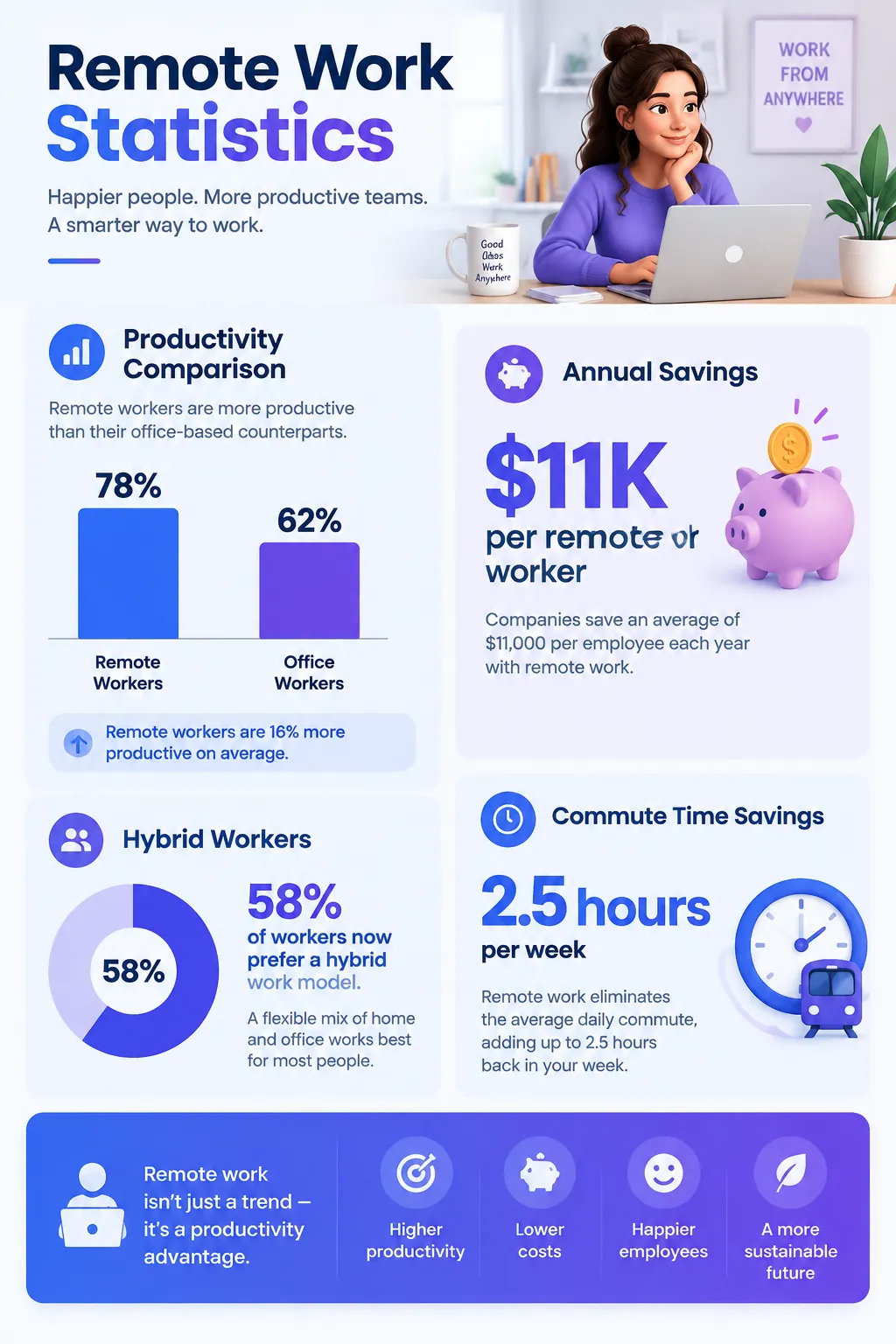
Remote work data: 58% of knowledge workers hybrid, measurable productivity gains, $11K annual savings per remote employee, and rising satisfaction scores.
Published
Generate a custom version of this infographic
Customize with your own data, style, and branding
Generate This InfographicKey Comparisons
Comparing Remote Work Productivity Statistics
Remote and hybrid work models have permanently reshaped the modern workplace following the global shift accelerated in 2020. Today, approximately 58 percent of knowledge workers operate in hybrid arrangements, combining home and office days based on role requirements and team collaboration needs. Multiple large-scale studies show that remote workers maintain or exceed in-office productivity levels, with self-reported output increases of 13 to 22 percent among fully remote employees in technology and professional services sectors
Employers benefit from reduced real estate costs averaging $11,000 per remote worker annually, while employees save an average of 72 minutes per day on commuting. Distributed teams also tap broader talent pools, with 65 percent of companies reporting improved hiring outcomes when location requirements are removed. Employee satisfaction and retention rates are notably higher among organizations offering flexible work policies, with turnover dropping by up to 25 percent in some cohorts
However, challenges persist around onboarding new hires, maintaining team cohesion, and preventing burnout from always-on digital culture. Companies investing in async communication tools, clear performance metrics, and intentional in-person gatherings report the strongest outcomes. The data suggests remote work is not a temporary trend but a structural shift requiring updated management practices and infrastructure investment.
Hybrid is not a compromise between fully remote and fully office; it is a scheduling problem. Roughly 58 percent of knowledge workers now blend home and onsite days, which means managers must decide which tasks require colocation and which benefit from quiet focus time. Stanford-linked research showing 13 to 22 percent higher self-assessed productivity among fully remote technology and professional services workers suggests output metrics should be outcome-based, yet collaboration-heavy roles still gain from periodic face time without mandating five-day commutes.
Employer economics and employee time savings pull in the same direction. Organizations save on average about $11,000 per remote worker annually in real estate and facilities per Global Workplace Analytics estimates, while workers reclaim near seventy-two minutes daily formerly lost to commuting per Owl Labs surveys. Those minutes often convert to extended work blocks or caregiving flexibility, which feeds satisfaction scores and explains turnover reductions up to 25 percent where flexible policies are credible, not cosmetic.
Recruiting geography expands when location requirements drop. Roughly 65 percent of companies report better hiring outcomes without mandatory office presence, accessing specialists outside high-cost hubs. FlexJobs-linked surveys show a large majority of candidates rank remote flexibility among top job criteria, so rigid office mandates quietly shrink applicant pools even when salary is competitive.
The tradeoff is onboarding and mentorship: new hires integrate slower without deliberate pairing, documentation, and office weeks. Async tools reduce meeting load but demand written norms so decisions do not stall across time zones. Managers who equate chat responsiveness with performance often misread deep work blocks at home, which is why explicit response windows and documented goals outperform always-on expectations for hybrid teams spread across regions.
Burnout and visibility bias remain the social risks. Always-on chat culture blurs boundaries unless leaders model offline hours, and proximity bias can reward present employees in hybrid setups unless promotion criteria are explicit. Video conferencing stabilized at several times pre-2020 enterprise usage, so investment shifts toward collaboration quality rather than mere connectivity. Through the late 2020s, hybrid likely stays the default for knowledge work, with industry-specific exceptions where hands-on production or regulated oversight requires physical presence daily.
Measurement choices shape the debate. Self-assessed productivity gains reported in surveys do not always match manager ratings or output metrics, and results differ by role, with focused individual work benefiting more than collaborative, high-ambiguity tasks. Firms that track outcomes such as delivery cycle time, customer satisfaction, and case or code throughput get a clearer picture than those relying on attendance or activity signals alone. Clear team agreements about core collaboration hours also reduce the coordination costs that hybrid schedules can create.
Frequently Asked Questions
Is remote work less productive than working in an office?
How much money do companies save with remote work?
What are the biggest challenges of remote work?
Will hybrid work become the permanent standard?
Sources
- Stanford Institute for Economic Policy Research, 2024
- Gartner Future of Work Survey, 2025
- Global Workplace Analytics, 2024
- Owl Labs State of Remote Work, 2025
Source links go to each publisher's official website.
Embed This Infographic
Copy the code below to share this infographic on your website
<a href="https://www.makeinfographics.ai/infographic/remote-work-productivity" target="_blank" rel="noopener">
  <img src="https://pic-cdn.chibistyle.app/infographics/infographics/remote-work.webp"
       alt="Remote Work Productivity Statistics — Remote work data: 58% of knowledge workers hybrid, measurable productivity gains, $11K annual saving"
       width="960" height="1440" loading="lazy"
       style="max-width:100%;height:auto;" />
</a>
<p>Source: <a href="https://www.makeinfographics.ai">MakeInfographics.ai</a> — Free AI Infographic Generator</p>
Create Your Own Remote Work Productivity Statistics Infographic
Customize this topic with your own data, style, and branding
Create Custom Version — FreeMake Something for Your Own Life
Free printable planners, blank or filled in by AI from your details.


Related Infographics
All Technology & SaaS infographics →Edge Computing Infrastructure Statistics 2026
Edge computing infrastructure spending reached $92 billion in 2026, up 24%. See latency benchmarks, 5G small-cell growth, IoT scale, and key use cases.
Autonomous Vehicle Safety Statistics 2026
Self-driving car safety data, accident rates vs human drivers, sensor technology layers, regulatory milestones, and AV deployment statistics worldwide.
Robotic Process Automation (RPA) Statistics & Market Trends 2026
RPA market data: $22B industry valuation, 65% enterprise adoption, bot deployment stats, cost savings metrics, and leading automation use cases.
5G & 6G Network Technology Evolution
5G reaches 2.2B people in 95+ countries; Korea tops 75% adoption. $280B spend, 25B IoT links, and 6G terabit goals toward 2030.