

Global E-Learning Market Growth Infographic
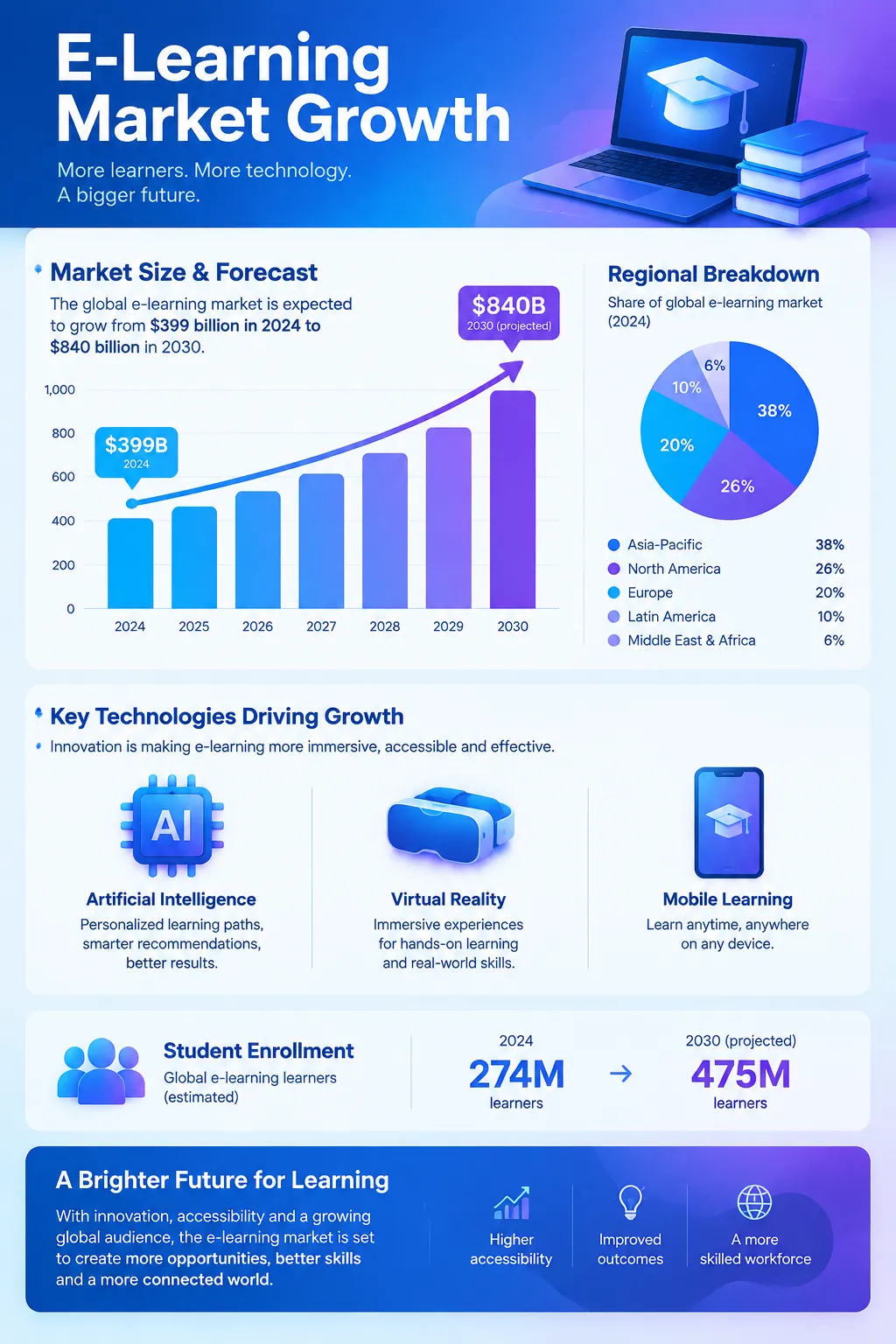
Global e-learning neared $460B in 2026 after $399B in 2025, heading toward $840B by 2030. Corporate share, Asia-Pacific growth, and key tech drivers.
Published
Generate a custom version of this infographic
Customize with your own data, style, and branding
Generate This InfographicKey Statistics
- 1The global e-learning market was valued at approximately 399 billion USD in 2025 (Statista, 2025)
- 2Market projected to reach 840 billion USD by 2030, growing at 16% CAGR (Grand View Research, 2025)
- 3Corporate e-learning represents the largest segment at 45% of total market revenue (Research and Markets, 2025)
- 4Asia-Pacific is the fastest-growing regional market with 19% annual growth rate (Mordor Intelligence, 2025)
- 5Over 220 million students worldwide enrolled in at least one online course in 2025 (UNESCO, 2025)
- 6Mobile learning accounts for 67% of all e-learning access in developing nations (GSMA, 2025)
- 7AI-powered adaptive learning platforms improve student outcomes by up to 35% (McKinsey, 2024)
- 8The average corporate training budget allocation for digital learning rose from 38% in 2020 to 72% in 2025 (LinkedIn Learning, 2025)
About Global E-Learning Market Growth
The global e-learning market has experienced explosive growth over the past decade, accelerating dramatically after the pandemic forced educational institutions and corporations worldwide to adopt digital learning solutions. Valued at approximately 399 billion US dollars in 2025, the market is projected to surpass 840 billion dollars by 2030, growing at a compound annual growth rate of around 16 percent. This transformation extends far beyond emergency remote learning — it represents a fundamental shift in how knowledge is created, delivered, and consumed across every sector of society.
Corporate e-learning accounts for the largest revenue segment, with companies investing heavily in upskilling and reskilling their workforces to keep pace with technological change. The average large enterprise now spends over 1,500 dollars per employee annually on digital training programs. Higher education follows as the second-largest segment, with universities worldwide offering fully online degree programs that reach students regardless of geographic location. K-12 education has also embraced blended learning models, combining in-person instruction with digital tools to create more personalized and flexible learning experiences.
North America currently leads the market in revenue share, driven by advanced digital infrastructure and high technology adoption rates. However, the Asia-Pacific region is the fastest-growing market, fueled by massive populations, increasing internet penetration, and government initiatives promoting digital literacy. Countries like India, China, and Indonesia are seeing enrollment surges in online platforms, with mobile-first learners driving a new wave of accessible education. Europe maintains steady growth through strong regulatory support for lifelong learning programs, while Africa and Latin America represent emerging frontiers where e-learning is bridging critical gaps in educational access.
Key technologies driving the next phase of e-learning include artificial intelligence for adaptive learning pathways, virtual and augmented reality for immersive experiences, microlearning platforms for just-in-time skill acquisition, and blockchain for verifiable digital credentials. The convergence of these technologies is creating learning experiences that are more engaging, personalized, and measurable than traditional classroom instruction, setting the stage for continued market expansion well into the next decade.
Corporate training budgets explain much of the revenue concentration in digital learning. That shift persists because skills half-lives shortened in technology roles and remote teams need asynchronous modules that classroom schedules cannot supply. Completion analytics and skills tagging tie learning to hiring and promotion pipelines in ways traditional workshops rarely documented.
Higher education and K-12 segments follow different adoption curves. Universities monetize fully online degrees and hybrid residencies that export brand beyond campus geography, while school systems blend in-person teaching with platforms that personalize practice and catch learning gaps.
Asia-Pacific’s faster regional growth rate reflects demographics plus mobile-first access patterns. In developing markets, roughly two-thirds of e-learning sessions occur on phones per GSMA-linked estimates, favoring short modules and offline-capable apps. North America still leads absolute revenue given enterprise density, while Europe benefits from policy frameworks that subsidize lifelong learning. Africa and Latin America remain underserved relative to demand, which defines the next wave of platform investment if connectivity costs fall.
Technology convergence is the operational story behind headline market size near $460 billion in 2026 extrapolated from 2025 baselines. Adaptive AI pathways, immersive VR labs for hazardous jobs, micro-credentials on blockchain, and integration with HR systems turn content libraries into measurable capability building. Outcome studies citing up to 35 percent improvement on adaptive platforms reinforce CFO willingness to fund digital curricula through 2030, when Grand View Research-style forecasts place the market toward $840 billion at mid-teens CAGR.
Completion remains the sector's persistent weakness. Open online courses historically see low finish rates, so providers increasingly add cohorts, mentoring, and assessments tied to job outcomes. Buyers should evaluate platforms on learner engagement and verified skills gained rather than on catalog size alone, and should plan for accessibility, captioning, and data privacy requirements from the start.
Frequently Asked Questions
What is driving the growth of the e-learning market?
How big is the global e-learning market in 2026?
Which region is growing fastest in online education?
What technologies are shaping the future of e-learning?
Is corporate e-learning more effective than traditional training?
Sources
- Grand View Research, E-Learning Market Report 2025
- UNESCO Global Education Monitoring Report, 2025
- Statista, Online Education Market Size Worldwide, 2025
- McKinsey & Company, How Technology Is Shaping Learning, 2024
- LinkedIn Learning Workplace Learning Report, 2025
Source links go to each publisher's official website.
Embed This Infographic
Copy the code below to share this infographic on your website
<a href="https://www.makeinfographics.ai/infographic/e-learning-market-growth" target="_blank" rel="noopener">
  <img src="https://pic-cdn.chibistyle.app/infographics/infographics/e-learning.webp"
       alt="Global E-Learning Market Growth — Global e-learning neared $460B in 2026 after $399B in 2025, heading toward $840B by 2030. Corporate "
       width="960" height="1440" loading="lazy"
       style="max-width:100%;height:auto;" />
</a>
<p>Source: <a href="https://www.makeinfographics.ai">MakeInfographics.ai</a> — Free AI Infographic Generator</p>
Create Your Own Global E-Learning Market Growth Infographic
Customize this topic with your own data, style, and branding
Create Custom Version — FreeMake Something for Your Own Life
Free printable planners, blank or filled in by AI from your details.



Related Infographics
All Education infographics →EdTech Funding Timeline 2015-2026
EdTech funding rebounded to $24B in 2026 on a $400B market. Timeline from 2015 through AI tutoring, pandemic surge, and global growth.
AI-Powered Personalized Learning Statistics & Trends 2026
AI in education data: $28B adaptive learning market, student outcome improvements, AI tutor adoption rates, and personalized curriculum effectiveness.
Online Learning Platforms Comparison 2026
Coursera, Udemy, edX & LinkedIn Learning compared: 185B e-learning market, pricing, completion rates, and certificate value in 2026.
Microlearning & Mobile Education Statistics 2026
Microlearning data visualized: $4.2B market, 80% higher retention vs traditional learning, mobile adoption rates, and corporate training ROI metrics.