

EdTech Funding Timeline 2015-2026 Infographic
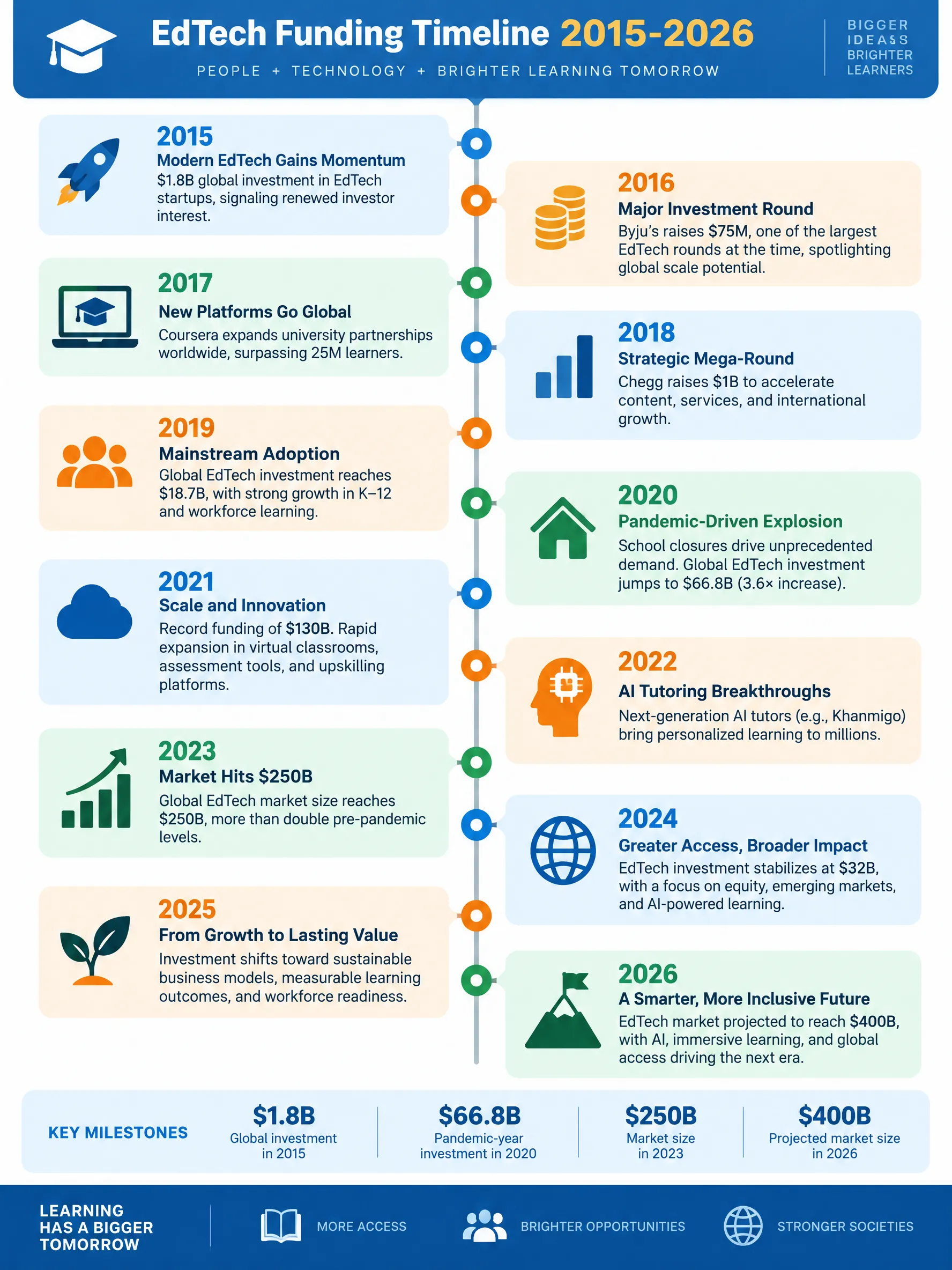
Education technology investment milestones from 2015-2026: major funding rounds, pandemic-driven growth, AI tutoring breakthroughs, and global market expansion timeline.
Published
Generate a custom version of this infographic
Customize with your own data, style, and branding
Generate This InfographicKey Milestones
Timeline of EdTech Funding Timeline 2015-2026
The education technology sector has undergone a remarkable transformation over the past decade, evolving from a niche segment to a $400 billion global industry. This timeline traces the key milestones, funding events, and technological breakthroughs that shaped modern EdTech from 2015 through 2026.
2015-2017: Foundation Era. Global EdTech investment totaled $8 billion in 2015, concentrated in the US and China. Key milestones included Coursera reaching 20 million learners, Byju's raising its first major round ($75M Series C), and Duolingo surpassing 100 million users. Learning Management Systems (LMS) like Canvas and Google Classroom gained traction in K-12 and higher education. China's online education market reached $25 billion as parents embraced after-school tutoring platforms.
2018-2019: Scale-Up Period. Annual EdTech funding surged to $18.7 billion in 2019. Byju's became India's most valuable startup at $8 billion valuation. Yuanfudao and Zuoyebang in China raised billion-dollar rounds. Masterclass, Skillshare, and Udemy expanded professional and creative learning. VR/AR entered classrooms with Google Expeditions. Corporate learning platforms (Degreed, Pluralsight, LinkedIn Learning) captured enterprise budgets as upskilling became a strategic priority.
2020-2021: Pandemic Inflection Point. COVID-19 triggered the largest disruption in education history, pushing 1.6 billion students online virtually overnight. EdTech funding exploded to $20.8 billion in 2021 — a 140% increase from 2019. Zoom's daily meeting participants surged from 10 million to 300 million. Companies like Byju's ($21B valuation), Yuanfudao ($15.5B), and Course Hero ($3.6B) achieved unicorn-plus status. Google Classroom grew from 40 million to 150 million users. The crisis permanently shifted attitudes toward digital learning, with 70% of educators reporting they would continue blending online and in-person instruction.
2022-2023: Correction and Consolidation. A market correction hit EdTech valuations after pandemic-era over-investment. Byju's faced a dramatic downfall from $22B to under $3B amid governance issues. China's 2021 tutoring ban restructured the $100B Chinese EdTech market. Global funding dropped to $10.6 billion in 2023. However, this period saw strategic pivots: companies focused on profitability over growth, AI-first startups began emerging, and enterprise learning continued growing at 15% annually.
2024-2026: AI Revolution Era. Generative AI transformed EdTech fundamentally. ChatGPT's release in late 2022 catalyzed an AI tutoring wave — by 2026, AI-powered adaptive learning platforms serve 350 million students globally. Khan Academy's Khanmigo AI tutor reached 10 million users. Duolingo Max integrated GPT-4 for conversational practice. Funding rebounded to $24 billion in 2026 as investors backed AI-native education companies. Key milestones: AI tutors demonstrated learning gains equivalent to human tutoring in randomized trials (2025), AI-powered assessment tools reduced teacher grading workload by 40%, and personalized learning paths improved student retention by 25%. The global EdTech market reached $400 billion, with the fastest growth in India ($12B), Southeast Asia ($8B), and Latin America ($5B).
Frequently Asked Questions
How has AI changed education technology?
What happened to EdTech after the pandemic boom?
Which EdTech segments are growing fastest?
Sources
- HolonIQ, Global EdTech Market Intelligence, 2026
- Crunchbase, EdTech Investment Data, 2015-2026
- UNESCO, COVID-19 Education Response, 2020
- Journal of Educational Psychology, AI Tutoring Efficacy Studies, 2025
- RedSeer Consulting, India EdTech Market Report, 2026
Source links go to each publisher's official website.
Embed This Infographic
Copy the code below to share this infographic on your website
<a href="https://www.makeinfographics.ai/infographic/education-technology-edtech-funding-2026" target="_blank" rel="noopener">
  <img src="https://www.makeinfographics.ai/images/infographics/edtech-funding-timeline.webp"
       alt="EdTech Funding Timeline 2015-2026 — Education technology investment milestones from 2015-2026: major funding rounds, pandemic-driven gro"
       width="960" height="1280" loading="lazy"
       style="max-width:100%;height:auto;" />
</a>
<p>Source: <a href="https://www.makeinfographics.ai">MakeInfographics.ai</a> — Free AI Infographic Generator</p>
Create Your Own EdTech Funding Timeline 2015-2026 Infographic
Customize this topic with your own data, style, and branding
Create Custom Version — FreeRelated Infographics
All Education infographics →Space Exploration Milestones
Humanity's space timeline: Moon landing, ISS, Mars rovers, James Webb discoveries, Artemis program, and the rise of commercial spaceflight.
Global E-Learning Market Growth
Explore the rapid expansion of the global e-learning market, from market size and revenue projections to adoption drivers, regional trends, and the technologies reshaping online education worldwide.
Student Loan Debt & Higher Education Costs Worldwide
Comparative analysis of student debt levels, tuition costs, and higher education ROI across major countries, with data on scholarships, loan forgiveness, and graduation rates.
Online Learning Platforms Comparison 2026
Side-by-side comparison of top online learning platforms including Coursera, Udemy, edX, and LinkedIn Learning, covering pricing, course quality, certification value, and completion rates.