

Space Exploration Milestones Infographic
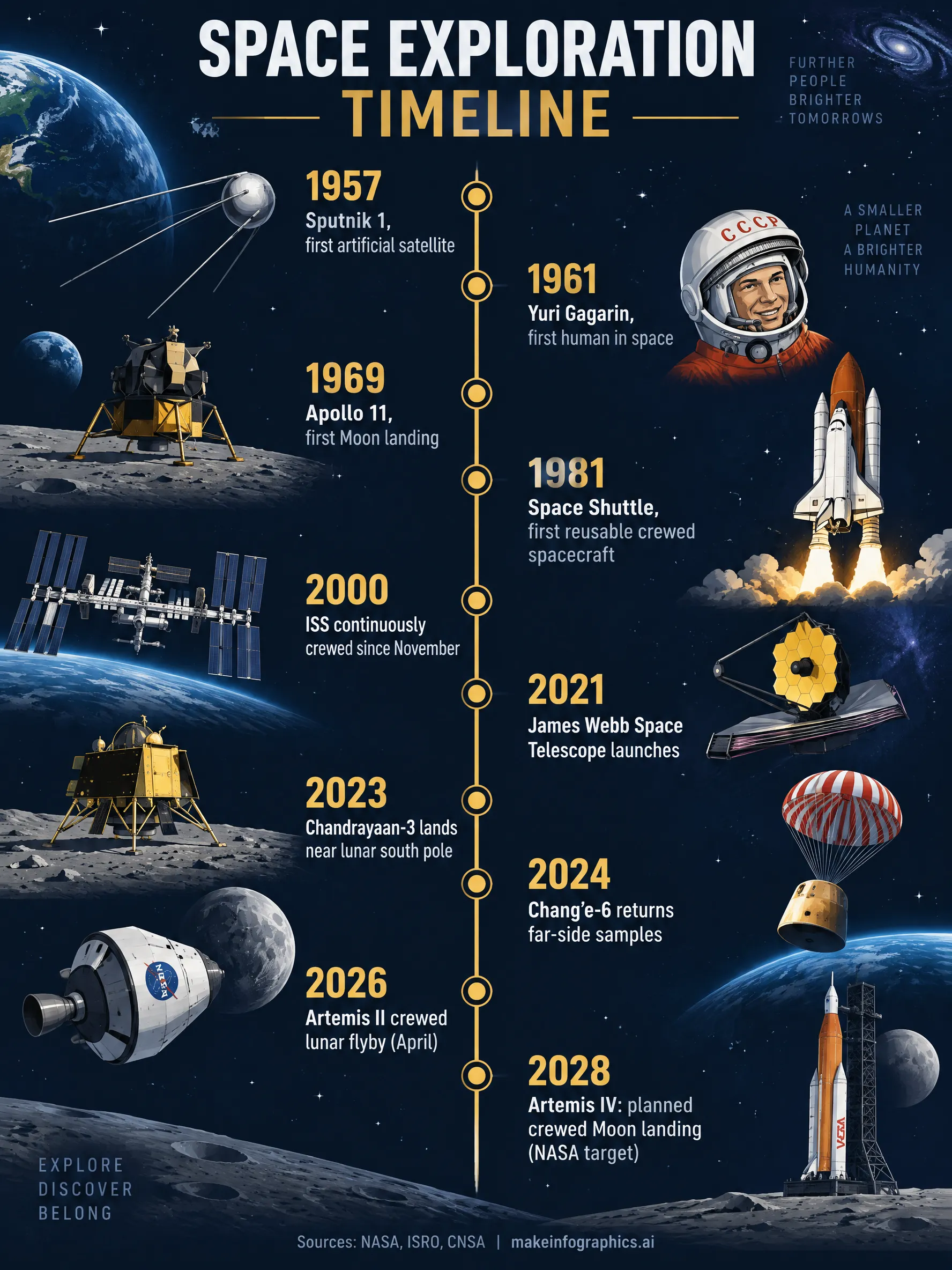
Space exploration timeline from Sputnik to Artemis II, Chandrayaan-3, Chang'e-6, Webb, Mars samples, commercial crew, and NASA's Moon plans through 2030.
Published · Updated
Generate a custom version of this infographic
Customize with your own data, style, and branding
Generate This InfographicKey Milestones
Timeline of Space Exploration Milestones
Humanity's push beyond Earth began as a Cold War technology contest and evolved into a multi-agency, increasingly commercial enterprise linking orbit, the Moon, and Mars. The Space Age opened on October 4, 1957, when the Soviet Union placed Sputnik 1 into orbit, prompting the United States to accelerate satellite work and create NASA in 1958. Crewed flight followed quickly: Apollo 11 landed Neil Armstrong and Buzz Aldrin on the Moon on July 20, 1969, while an estimated 650 million people watched Armstrong's first steps on television—a moment that proved human deep-space flight was possible and still shapes public support for exploration today.
Why did the first waves of milestones cluster in the 1950s and 1960s? Superpower rivalry funded large rockets before their economics made sense for science alone. Once the Moon race peaked, activity shifted toward reusable shuttles, space stations, and robotic probes that could stay years on Mars or stare for months at a single patch of sky. That pattern—political urgency first, then sustained laboratories and robots—still explains why crewed lunar return took decades after Apollo.
Continuous human presence in low Earth orbit became the next anchor milestone. Expedition 1 arrived at the International Space Station on November 2, 2000, starting uninterrupted habitation that NASA still reports more than two decades later. Partners from five space agencies operate the outpost, and NASA lists 298 individuals from 26 countries who have visited, including 13 private spaceflight participants. The station's microgravity research matured while NASA's Commercial Crew Program, certified for SpaceX in November 2020, began rotating astronauts from Florida on Falcon 9 and Dragon—freeing NASA to focus Artemis hardware on the Moon.
Robotic Mars exploration supplied the scientific runway for eventual crewed landings. NASA's Perseverance rover, part of Mars 2020, has sealed rock, regolith, and atmosphere samples in titanium tubes; NASA documented 33 tubes used for sampling as of July 24, 2025, with ten tubes cached at the Three Forks depot for a potential future return campaign. Orbiting colleagues relay data and hunt subsurface ice while planners study how to bring those tubes home without contaminating Earth's biosphere.
Observatories extended the timeline into cosmic history. The James Webb Space Telescope launched on December 25, 2021, on an ESA-provided Ariane 5 from French Guiana, reaching its Sun–Earth L2 observing station as a NASA–ESA–CSA partnership. Webb's infrared eyes enabled the JADES survey to spectroscopically confirm galaxies less than 400 million years after the big bang, including candidates above redshift 13—far earlier than pre-Webb catalogs. Such findings do not replace Hubble's legacy; they measure when stars and galaxies first lit up, informing every model of how habitable worlds could later form.
Asian lunar programs added fresh milestones after Apollo. India's ISRO soft-landed the Chandrayaan-3 Vikram lander near the Moon's south polar region on August 23, 2023, deploying the Pragyan rover for in-situ measurements NASA also tracks as an international science mission. China's CNSA went farther in 2024: Chang'e-6 launched May 3, collected material from the lunar far side within the South Pole–Aitken Basin, and returned a capsule to Inner Mongolia on June 25, 2024—the first far-side sample return. CNSA measured 1,935.3 grams delivered for research on June 28, 2024, giving planetary scientists terrain no Apollo or Chang'e-5 mission sampled.
NASA's Artemis campaign reopened deep space for American crews after Artemis I's uncrewed lunar flight test launched November 16, 2022, and splashed down December 11, 2022. Artemis II—the first crewed Artemis flight—launched April 1, 2026, carrying Reid Wiseman, Victor Glover, Christina Koch, and CSA astronaut Jeremy Hansen around the Moon; they flew a lunar flyby on April 6, 2026, and splashed down April 10, 2026, traveling farther from Earth than Apollo 13's record distance. NASA's updated architecture makes Artemis III a 2027 low Earth orbit demonstration to practice Orion docking with commercial Human Landing System test articles from SpaceX and Blue Origin, while Artemis IV targets the first crewed lunar surface landing since Apollo in early 2028, with Artemis V following toward a sustained Moon presence.
The commercial era is no longer a footnote on the timeline. NASA procures crew and cargo flights from private providers, awards additional SpaceX crew missions through 2030, and expects industry to operate successor stations before the ISS retires. NASA commits to using the station through 2030 while transitioning research to commercial low Earth orbit platforms, aiming for crewed commercial demonstrations in that same timeframe so microgravity science continues without a government-owned outpost.
Looking toward the 2030s, three goals dominate official plans: establish recurring lunar landings and surface infrastructure through Artemis; execute Mars sample return built on Perseverance's cached tubes; and keep humans in LEO via commercial stations after ISS deorbit. Reusable heavy-lift development tied to NASA's Human Landing System contracts connects those threads—test articles must prove docking, propellant, and life-support interfaces before astronauts ride landers to the south polar region. Space sustainability also joins the milestone list: more visitors, more landers, and more satellites demand debris mitigation and careful traffic management as exploration scales.
From Sputnik's beep to Artemis II's lunar flyby, each marker reflects the tools available in its decade—rockets driven by rivalry, laboratories built for cooperation, robots and telescopes that outstay any single crew. The timeline continues to accelerate because governments set destinations while companies supply cadence, turning once-rare launches into the infrastructure for science, navigation, and the next human steps on the Moon.
Frequently Asked Questions
Did Artemis II already fly around the Moon?
When will NASA land astronauts on the Moon again?
What did Chandrayaan-3 achieve for India?
Why is the Chang'e-6 sample return scientifically important?
What happens to the International Space Station after 2030?
How many Mars samples has Perseverance collected?
Sources
- National Aeronautics and Space Administration (NASA), Artemis Mission Pages, 2026
- Indian Space Research Organisation (ISRO), Chandrayaan-3 Monthly Summary, 2023
- China National Space Administration (CNSA), Chang'e-6 Mission Releases, 2024
- European Space Agency (ESA), James Webb Space Telescope Overview, 2024
- National Aeronautics and Space Administration (NASA), ISS Transition Plan FAQs, 2024
Source links go to each publisher's official website.
Embed This Infographic
Copy the code below to share this infographic on your website
<a href="https://www.makeinfographics.ai/infographic/space-exploration-milestones" target="_blank" rel="noopener">
  <img src="https://pic-cdn.chibistyle.app/infographics/infographics/space-exploration.webp"
       alt="Space Exploration Milestones — Space exploration timeline from Sputnik to Artemis II, Chandrayaan-3, Chang'e-6, Webb, Mars samples,"
       width="960" height="1280" loading="lazy"
       style="max-width:100%;height:auto;" />
</a>
<p>Source: <a href="https://www.makeinfographics.ai">MakeInfographics.ai</a> — Free AI Infographic Generator</p>
Create Your Own Space Exploration Milestones Infographic
Customize this topic with your own data, style, and branding
Create Custom Version — FreeMake Something for Your Own Life
Free printable planners, blank or filled in by AI from your details.

Related Infographics
All Education infographics →EdTech Funding Timeline 2015-2026
EdTech funding rebounded to $24B in 2026 on a $400B market. Timeline from 2015 through AI tutoring, pandemic surge, and global growth.
STEM Education Gender Gap Statistics 2026
U.S. women earn 28% of engineering and 22% of CS degrees in 2026 while holding 27% of STEM jobs—see gap trends and fixes.
Evidence-Based Study Techniques: What Works in 2026
Evidence-based study techniques guide: Dunlosky et al. rated practice testing and spaced practice high utility; highlighting and rereading low utility.
Early Childhood Education: The Evidence 2026
Research-backed benefits of pre-K education: cognitive development, school readiness, lifetime earnings impact, enrollment rates, and program ROI data.