

Evidence-Based Study Techniques: What Works in 2026 Infographic
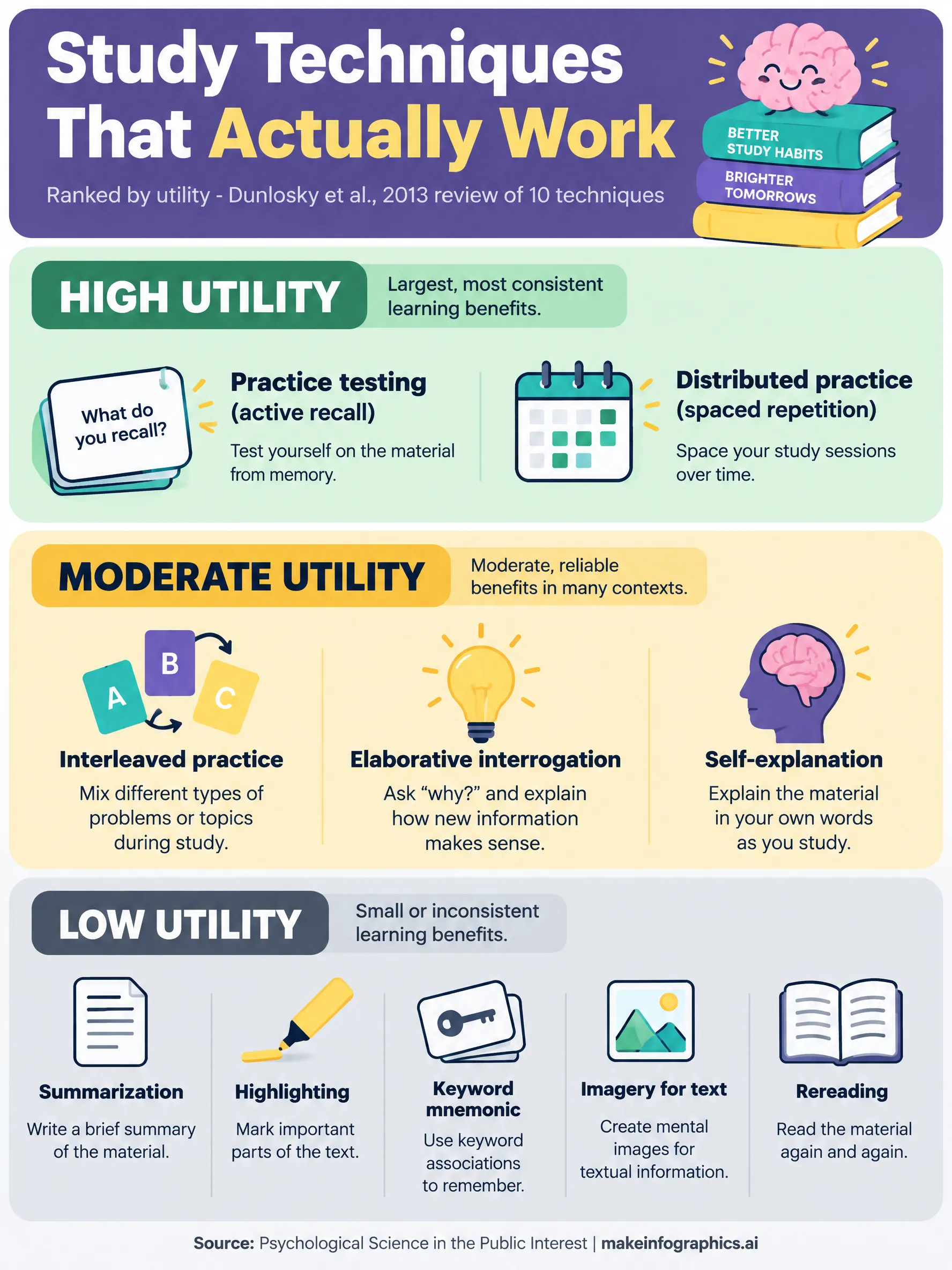
Evidence-based study techniques guide: Dunlosky et al. rated practice testing and spaced practice high utility; highlighting and rereading low utility.
Published
Generate a custom version of this infographic
Customize with your own data, style, and branding
Generate This InfographicKey Insights
- 1Dunlosky et al. reviewed 10 learning techniques; practice testing and distributed practice received high utility ratings (Association for Psychological Science, Psychological Science in the Public Interest, 2013)
- 2Five techniques received low utility, including highlighting or underlining and rereading (Association for Psychological Science, Psychological Science in the Public Interest, 2013)
- 3Adesope et al. reported an overall fixed-effects Hedges's g of 0.61 for practice testing versus non-testing conditions across 272 effect sizes (American Educational Research Association, Review of Educational Research, 2017)
- 4Practice testing outperformed restudying or rereading with g = 0.51 in the same meta-analysis (American Educational Research Association, Review of Educational Research, 2017)
- 5Cepeda et al. analyzed 839 distributed-practice assessments from 317 experiments reported in 184 articles (American Psychological Association, Psychological Bulletin, 2006)
- 6The IES practice guide offers seven recommendations, led by spacing key content across at least two sessions weeks to months apart (Institute of Education Sciences, Organizing Instruction and Study to Improve Student Learning, 2007)
- 7IES cites a spacing rule of thumb: inter-study intervals should not be less than about 5% of the required retention interval (Institute of Education Sciences, Organizing Instruction and Study to Improve Student Learning, 2007)
Guide to Evidence-Based Study Techniques: What Works in 2026
Students rarely lack effort; they lack strategies that survive a real exam week. Cognitive psychologists have tested dozens of study habits, but three syntheses still anchor practical advice: Dunlosky and colleagues' utility review of ten common techniques, the U.S. Institute of Education Sciences practice guide on organizing instruction and study, and quantitative meta-analyses on retrieval practice and distributed practice. Together they describe a clear split. Some habits reliably strengthen memory and transfer; others feel productive because the page looks familiar, not because recall improves.
Dunlosky et al. evaluated ten techniques students can use on their own, from highlighting to self-testing, and sorted each into high, moderate, or low utility based on whether benefits generalize across ages, materials, and test types. Only two earned high utility: practice testing (retrieval practice) and distributed practice (spacing study over time). Three received moderate utility: elaborative interrogation, self-explanation, and interleaved practice. Five were rated low utility, including summarization, the keyword mnemonic, imagery for text, highlighting or underlining, and rereading. The authors explicitly note that many students lean on rereading and highlighting even though those methods do not consistently raise performance, and they recommend substituting retrieval when possible.
That ranking is not anti-reading; it is anti-passive familiarity. Rereading can lift short-term recognition, especially on massed repeats, yet Dunlosky's team judged it low utility because gains are uneven on comprehension and inference tasks and because spaced rereading still loses to retrieval in head-to-head work. Survey data cited in the same review shows how entrenched rereading is: in one study of undergraduates at a highly selective university, 84 percent listed rereading among their techniques and 55 percent ranked it as their most frequent method. Highlighting suffers a different failure mode. Marking text can help memory for the exact lines you paint, but typical student highlighting is so broad that it adds little beyond rereading and may even hurt inference questions when connections across paragraphs matter more than isolated sentences.
Practice testing addresses the familiarity trap by forcing the brain to reconstruct answers. Adesope et al. meta-analyzed 118 articles reporting 272 independent effect sizes and 15,427 participants. Under a fixed-effects model, practice testing beat non-testing learning conditions with an overall Hedges's g of 0.61. Comparisons were heterogeneous, yet the pattern held against the habits students often substitute: g was 0.51 relative to restudying or rereading, and larger against filler or no-activity controls. Mechanistically, retrieving an answer strengthens the same pathways an exam will demand later, which is why flashcards, blank-page recall, and low-stakes quizzes belong in a weekly plan even when they feel harder than recopying notes.
Distributed practice spreads those retrieval episodes across days or weeks instead of stacking them in one cram block. Cepeda et al. synthesized 839 assessments drawn from 317 experiments in 184 articles and showed that the gap between study sessions and the gap until the final test interact: longer retention goals generally call for longer interstudy intervals, with benefits that are nonmonotonic rather than "more delay always wins." The IES practice guide translates that science into classroom scheduling: expose each major concept on at least two occasions separated by weeks to months, use homework and cumulative quizzes to re-expose material, and treat spacing as an efficiency gain rather than extra total study time. The panel also notes a rule of thumb from laboratory spacing work: the interval between study sessions should not be less than about 5 percent of the time you need to retain the material, while overshooting optimal spacing is usually less costly than cramming.
Interleaving—mixing problem types or topics within a session—earned moderate utility in Dunlosky's review because benefits are promising, especially in mathematics, but the literature is still smaller and null results appear when learners have not mastered individual skills yet. Treat interleaving as a second-phase tactic after you can solve single-type problems, not as a substitute for initial instruction.
A practical weekly architecture follows the evidence hierarchy. First, convert notes into questions and use them on a delayed schedule rather than rereading the same chapter twice in one evening. Second, calendar reviews at increasing intervals aligned with your exam dates, borrowing the IES emphasis on cumulative low-stakes tests. Third, keep highlighting only if it is selective and paired with self-explanation; otherwise swap the highlighter for a blank sheet. Fourth, add interleaved problem sets once basics are stable. The infographic paired with this guide visualizes the utility tiers so you can audit your current routine in minutes and reallocate time toward strategies with the strongest independent support.
Frequently Asked Questions
Which study techniques have the strongest research support?
Why is rereading popular if evidence favors retrieval?
How big is the testing effect compared with restudying?
How should I space study sessions before an exam?
Is highlighting ever useful?
When should I use interleaving?
Sources
- Association for Psychological Science, Improving Students' Learning With Effective Learning Techniques, 2013
- Institute of Education Sciences, Organizing Instruction and Study to Improve Student Learning, 2007
- American Educational Research Association, Review of Educational Research: Rethinking the Use of Tests (Adesope et al.), 2017
- American Psychological Association, Distributed Practice in Verbal Recall Tasks, 2006
Source links go to each publisher's official website.
Embed This Infographic
Copy the code below to share this infographic on your website
<a href="https://www.makeinfographics.ai/infographic/evidence-based-study-techniques-guide-2026" target="_blank" rel="noopener">
  <img src="https://pic-cdn.chibistyle.app/infographics/infographics/evidence-based-study-techniques.webp"
       alt="Evidence-Based Study Techniques: What Works in 2026 — Evidence-based study techniques guide: Dunlosky et al. rated practice testing and spaced practice hi"
       width="960" height="1280" loading="lazy"
       style="max-width:100%;height:auto;" />
</a>
<p>Source: <a href="https://www.makeinfographics.ai">MakeInfographics.ai</a> — Free AI Infographic Generator</p>
Create Your Own Evidence-Based Study Techniques: What Works in 2026 Infographic
Customize this topic with your own data, style, and branding
Create Custom Version — FreeRelated Infographics
All Education infographics →Early Childhood Education: The Evidence 2026
Research-backed benefits of pre-K education: cognitive development, school readiness, lifetime earnings impact, enrollment rates, and program ROI data.
EdTech Funding Timeline 2015-2026
EdTech funding rebounded to $24B in 2026 on a $400B market. Timeline from 2015 through AI tutoring, pandemic surge, and global growth.
AI-Powered Personalized Learning Statistics & Trends 2026
AI in education data: $28B adaptive learning market, student outcome improvements, AI tutor adoption rates, and personalized curriculum effectiveness.
Microlearning & Mobile Education Statistics 2026
Microlearning data visualized: $4.2B market, 80% higher retention vs traditional learning, mobile adoption rates, and corporate training ROI metrics.