

From Cacao Pod to Chocolate Bar: Production Process Infographic
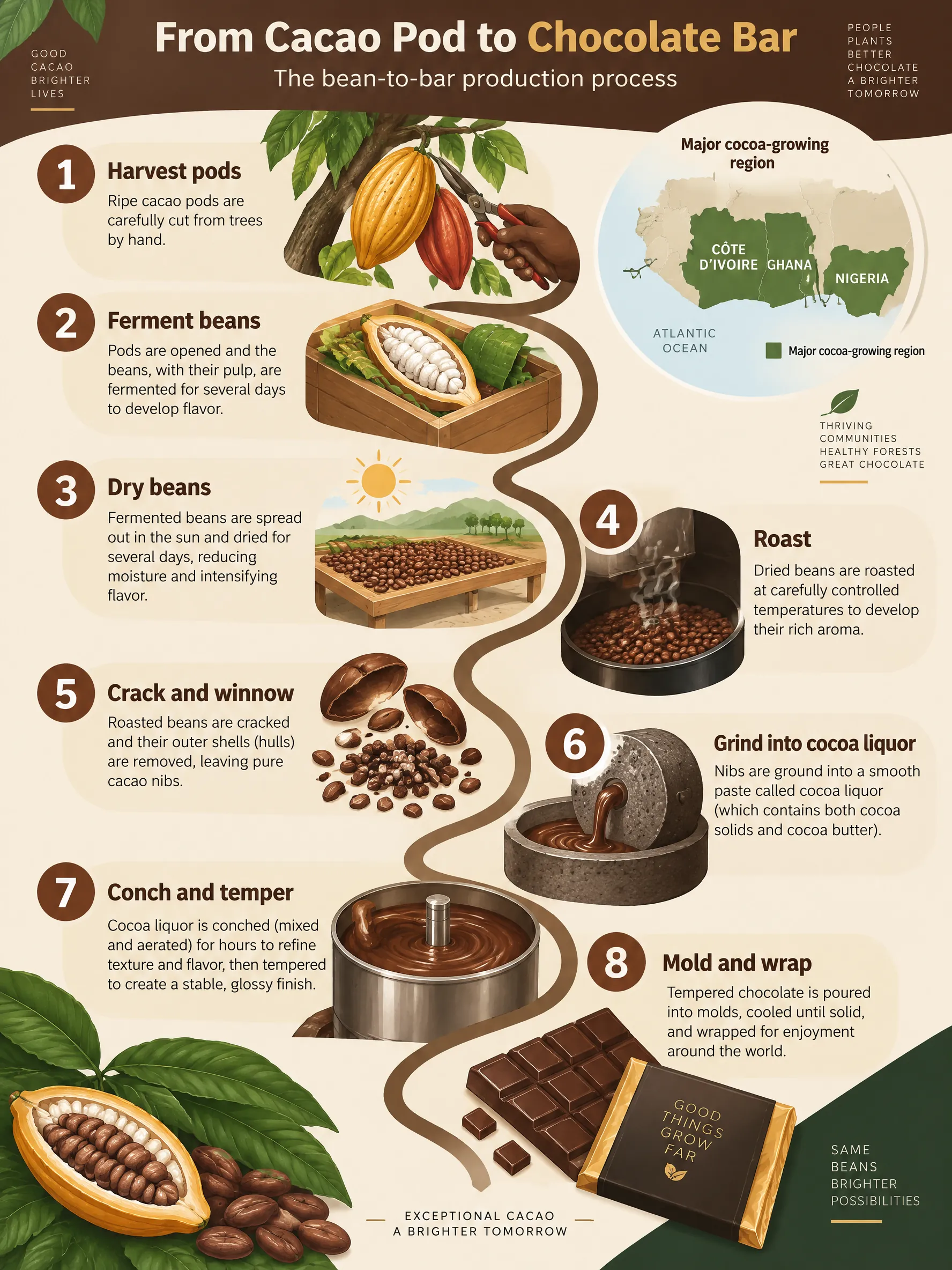
How chocolate is made, step by step: from cacao pod harvest and fermentation to roasting, conching, and tempering, with global cocoa supply facts.
Published
Generate a custom version of this infographic
Customize with your own data, style, and branding
Generate This InfographicProcess Steps
How From Cacao Pod to Chocolate Bar: Production Process
Chocolate begins as the seeds of the cacao tree, which grows in a narrow band of tropical forest near the equator. The International Cocoa Organization estimates world production at about 5.04 million tonnes in 2022/23, 4.37 million in 2023/24, and 4.70 million in 2024/25, with Africa supplying roughly 70 percent of beans and Cote d'Ivoire and Ghana together close to half of the global total (47.9 percent in 2023/24). The crop supports an estimated 5 to 6 million farmers, and the World Cocoa Foundation estimates that 40 to 50 million people depend on cocoa for their livelihoods. Understanding the production process helps explain why quality, price, and sustainability are so closely linked.
Step one is harvest. Farmers cut ripe pods from the trunk and branches by hand, because the trees are delicate and pods ripen at different times. Each pod holds a few dozen beans surrounded by sweet white pulp. After opening, the beans and pulp are piled in heaps or boxes and covered with leaves. This starts fermentation, which typically lasts five to seven days. Microbes consume the pulp, temperatures climb, and chemical changes inside the bean create the flavor precursors that later become chocolate taste. Poorly managed fermentation is one of the most common causes of flat or bitter chocolate, and no later step can fully repair it.
Step two is drying. Fermented beans are spread out in the sun for about a week and turned regularly until moisture falls to a level safe for storage and shipping. Rain, humidity, and smoke contamination from artificial drying can introduce off flavors, which is why drying infrastructure matters as much as the trees themselves. Dried beans are bagged and sold to local buyers or cooperatives, then shipped to processors and chocolate makers around the world.
Step three is roasting and winnowing. At the factory, beans are sorted, cleaned, and roasted, usually at temperatures between about 105 and 150 degrees Celsius depending on the bean origin and the desired flavor profile. Roasting develops aroma and loosens the shell. The beans are then cracked, and the papery husk is blown away in a process called winnowing, leaving small pieces of cocoa nibs. Nibs are the pure form of the bean and are naturally bitter, with a high fat content.
Step four is grinding. Nibs are milled until the friction and heat turn them into a thick liquid called cocoa liquor, which contains no alcohol despite the name. The liquor can be pressed to separate cocoa butter from cocoa solids, which are then milled into cocoa powder. Dark chocolate generally combines liquor with sugar and extra cocoa butter. Milk chocolate adds milk powder, and white chocolate uses cocoa butter without cocoa solids.
Step five is conching and tempering. Conching is a long mixing and aeration process, lasting from a few hours to a couple of days, that smooths texture and drives off unwanted volatile acids. Tempering then heats and cools the chocolate in a controlled pattern so that cocoa butter forms stable crystals, which gives finished bars their snap, gloss, and resistance to blooming. The tempered chocolate is poured into molds, cooled, wrapped, and shipped.
Origin and variety shape flavor as much as process. Most of the world's cocoa comes from hardy, high-yielding trees, while criollo and trinitario varieties are prized for fine aromatic flavor but yield less and are more vulnerable to disease. Chocolate makers who work bean to bar choose beans by origin, adjust roasting for each lot, and often publish tasting notes, much as coffee roasters do. That is why two bars with the same cocoa percentage can taste completely different.
The process also explains recent market volatility. Weather stress and crop disease in West Africa reduced supply, and cocoa prices reached record highs above 12,000 US dollars per tonne during 2024. Higher bean costs flow through to retail prices and push some manufacturers to reformulate or shrink products. For shoppers who want to buy responsibly, certification labels, direct trade relationships, and bean-to-bar makers who publish farm information can show more clearly where the money goes. As a rule, the closer a buyer is to the farm, the more transparent the process becomes.
Frequently Asked Questions
How is chocolate made from cacao beans?
Why is fermentation important for chocolate flavor?
Where does most of the world's cocoa come from?
What is the difference between cocoa liquor, cocoa butter, and cocoa powder?
Why did chocolate prices rise so much?
Sources
- International Cocoa Organization, Quarterly Bulletin of Cocoa Statistics, 2025
- World Cocoa Foundation, Cocoa Farmer and Livelihood Estimates, 2025
- Institute of Food Technologists, How Dark Chocolate Is Processed, 2024
Source links go to each publisher's official website.
Embed This Infographic
Copy the code below to share this infographic on your website
<a href="https://www.makeinfographics.ai/infographic/chocolate-production-process-cacao-to-bar-2026" target="_blank" rel="noopener">
  <img src="https://pic-cdn.chibistyle.app/infographics/infographics/chocolate-production-process.webp"
       alt="From Cacao Pod to Chocolate Bar: Production Process — How chocolate is made, step by step: from cacao pod harvest and fermentation to roasting, conching, "
       width="960" height="1280" loading="lazy"
       style="max-width:100%;height:auto;" />
</a>
<p>Source: <a href="https://www.makeinfographics.ai">MakeInfographics.ai</a> — Free AI Infographic Generator</p>
Create Your Own From Cacao Pod to Chocolate Bar: Production Process Infographic
Customize this topic with your own data, style, and branding
Create Custom Version — FreeRelated Infographics
All Food & Cuisine infographics →Global Aquaculture: Fish Farming Facts 2026
Aquaculture vs wild catch production data, top producing countries, species breakdown, sustainability metrics, and environmental impact comparisons.
Coffee Production Worldwide
Global coffee industry: Brazil and Vietnam lead production, 2.25 billion cups consumed daily, fair trade impact, and bean-to-cup supply chain.
Plant-Based Protein Market Growth 2026
Plant-based protein market reaches $20.7B in 2026—pea vs soy, 44% US household penetration, fermentation investment, and LCA data.
Global Food Safety Standards Overview 2026
Unsafe food causes 600M illnesses and 420,000 deaths yearly worldwide. HACCP, recalls, cold chain tech, and global food safety standards in 2026.