

Plant-Based Protein Market Growth 2026 Infographic
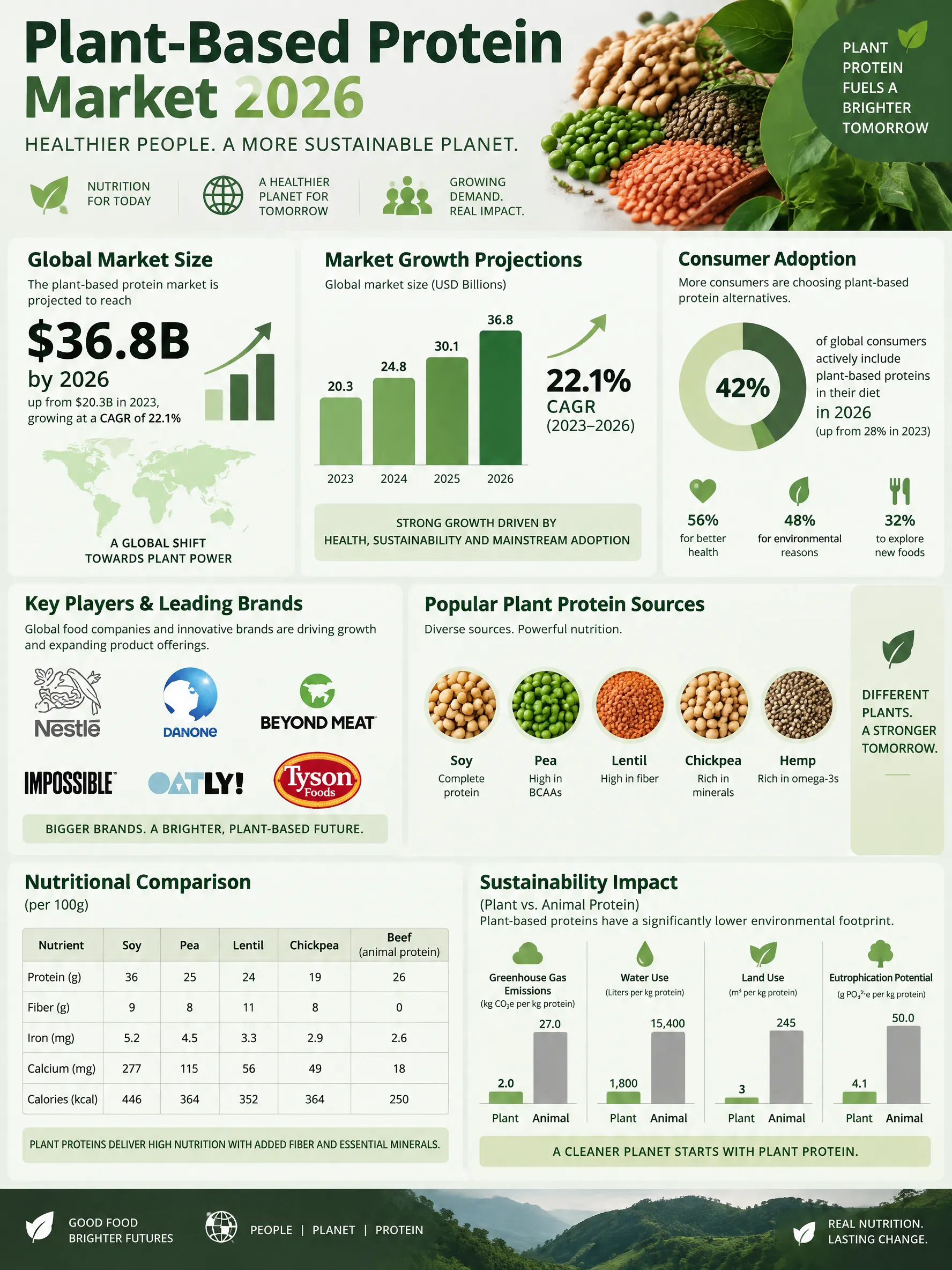
Plant-based protein market statistics for 2026: global market size exceeding $20 billion, consumer adoption trends, nutritional comparison with animal protein, and sustainability impact data.
Published
Generate a custom version of this infographic
Customize with your own data, style, and branding
Generate This InfographicKey Statistics
- 1Global plant-based protein market valued at $20.7 billion in 2026, growing at 12% CAGR (Grand View Research, 2026)
- 244% household penetration for plant-based products in North America (SPINS Retail Data, 2026)
- 3Pea protein usage grew 340% since 2020, surpassing soy in plant-based meat alternatives (Good Food Institute, 2026)
- 4Precision fermentation attracted $2.8 billion in investment in 2025-2026 (AgFunder, 2026)
- 5Plant-based proteins require 72-99% less land than animal proteins (Our World in Data / Poore & Nemecek meta-analysis)
- 665% repeat purchase rate among regular plant-based protein buyers (IRI Consumer Panel, 2026)
- 762% of corporate cafeterias now offer daily plant-based protein options (Sodexo Global Food Survey, 2026)
About Plant-Based Protein Market Growth 2026
The plant-based protein market has grown from a niche health food segment into a mainstream food industry force valued at $20.7 billion globally in 2026. Consumer demand is driven by a convergence of health consciousness, environmental awareness, and improved product quality that has dramatically narrowed the taste and texture gap with animal-derived proteins. Household penetration of plant-based products reached 44 percent in North America and 38 percent in Western Europe, with repeat purchase rates climbing to 65 percent among regular buyers.
Protein source diversity has expanded significantly. Soy remains the largest single ingredient by volume, but pea protein has grown 340 percent since 2020 and now powers the majority of plant-based meat alternatives. Emerging sources including mycelium-based proteins, algae-derived ingredients, and precision-fermented dairy proteins are gaining market share rapidly. Precision fermentation, which uses microorganisms to produce animal-identical proteins without animals, attracted $2.8 billion in investment during 2025-2026 and is projected to capture 10 percent of the dairy protein market by 2030.
Nutritional science has advanced to address historical criticisms. Modern plant-based formulations achieve complete amino acid profiles through strategic blending, with leading products matching or exceeding the protein digestibility-corrected amino acid scores (PDCAAS) of animal proteins. Fortification with B12, iron, zinc, and omega-3 DHA addresses micronutrient gaps that affected earlier generations of plant-based products.
The sustainability case continues to strengthen. Life cycle assessments show plant-based proteins require 72-99 percent less land, 47-84 percent less water, and generate 30-90 percent fewer greenhouse gas emissions than equivalent animal proteins. These metrics are increasingly influencing institutional food procurement, with 62 percent of corporate cafeterias now offering daily plant-based options and university dining halls reporting 35 percent plant-based meal selections.
Frequently Asked Questions
How big is the plant-based protein market in 2026?
Is plant-based protein as nutritious as animal protein?
What are the environmental benefits of plant-based protein?
What is precision fermentation and how does it relate to plant-based protein?
Sources
- Grand View Research, Plant-Based Protein Market Report, 2026
- Good Food Institute, State of the Industry Report, 2026
- AgFunder, Alternative Protein Investment Report, 2026
- SPINS Retail Data, Plant-Based Category Performance, 2026
- Our World in Data / Poore & Nemecek, Environmental Impact of Food Production
Source links go to each publisher's official website.
Embed This Infographic
Copy the code below to share this infographic on your website
<a href="https://www.makeinfographics.ai/infographic/plant-based-protein-market-growth-2026" target="_blank" rel="noopener">
  <img src="https://www.makeinfographics.ai/images/infographics/plant-based-protein.webp"
       alt="Plant-Based Protein Market Growth 2026 — Plant-based protein market statistics for 2026: global market size exceeding $20 billion, consumer a"
       width="960" height="1280" loading="lazy"
       style="max-width:100%;height:auto;" />
</a>
<p>Source: <a href="https://www.makeinfographics.ai">MakeInfographics.ai</a> — Free AI Infographic Generator</p>
Create Your Own Plant-Based Protein Market Growth 2026 Infographic
Customize this topic with your own data, style, and branding
Create Custom Version — FreeRelated Infographics
All Food & Cuisine infographics →Coffee Production Worldwide
Global coffee industry: Brazil and Vietnam lead production, 2.25 billion cups consumed daily, fair trade impact, and bean-to-cup supply chain.
World's Most Popular Cuisines Ranked
A visual ranking of the world's most popular cuisines based on global surveys — from Italian and Japanese to Mexican and Thai. Explore flavor profiles, signature dishes, and culinary influence by region.
World Street Food Guide by Country
A culinary journey through the world's best street food destinations, featuring iconic dishes, average prices, food safety ratings, and the cultural significance of street food globally.
Plant-Based Food Market Statistics 2026
Comprehensive overview of the $78 billion plant-based food market including meat alternatives, dairy substitutes, consumer demographics, nutritional data, and environmental impact.