

SMS Marketing Statistics & Compliance Checklist 2026 Infographic
SMS marketing checklist 2026: 2.2 trillion U.S. texts yearly, plus TCPA consent, opt-outs, 10DLC registration, and verified ecommerce SMS CTR benchmarks.
Published
Generate a custom version of this infographic
Customize with your own data, style, and branding
Generate This InfographicAction Items
Essential SMS Marketing Statistics & Compliance Checklist 2026
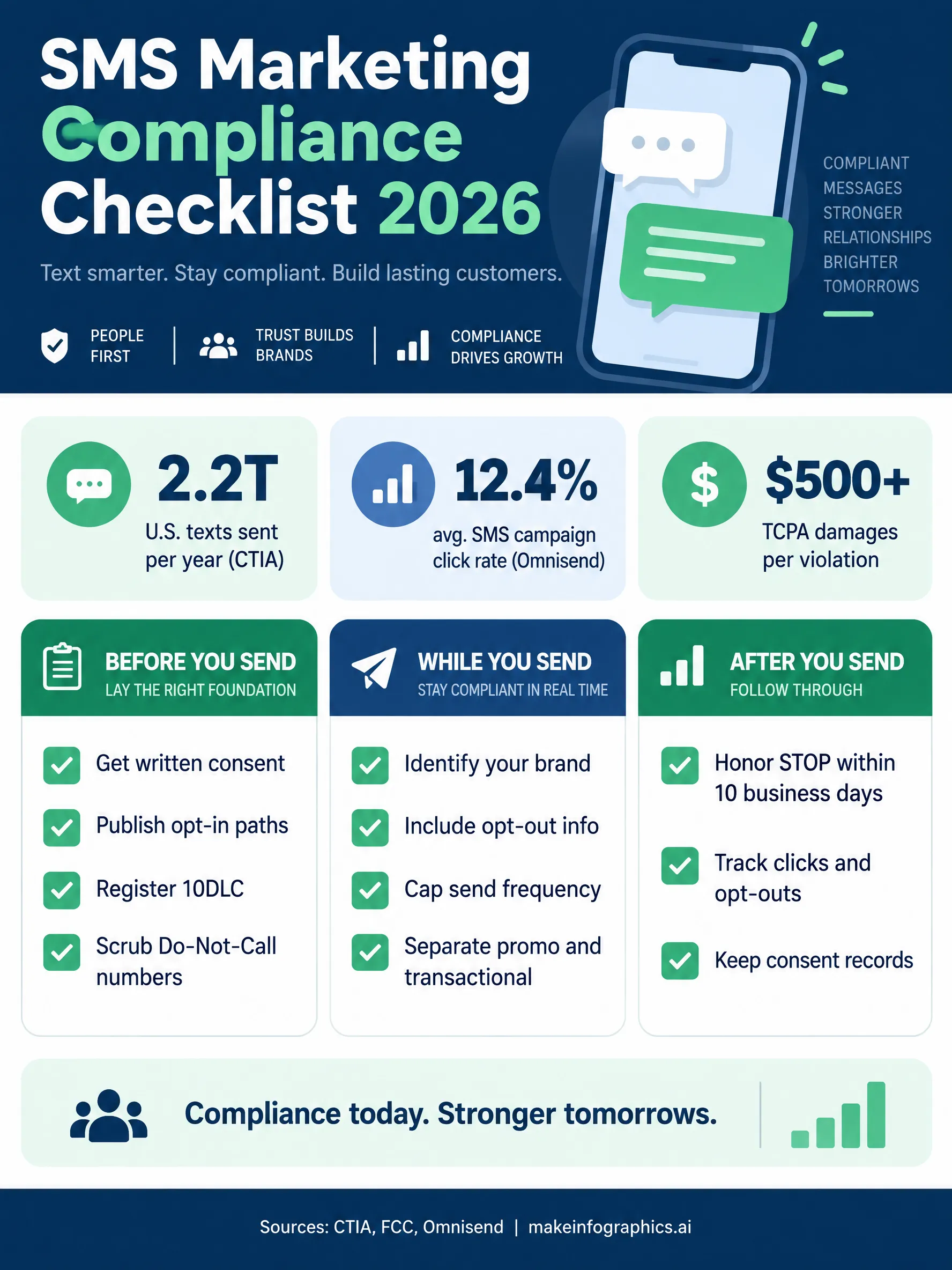
Text messaging sits in an unusual spot for marketers: consumers treat it as personal, carriers treat it as a protected channel, and regulators treat many promotional sends as telemarketing subject to the Telephone Consumer Protection Act. CTIA, the U.S. wireless trade association, notes that Americans exchange about 2.2 trillion text messages each year and that texts carry a 98 percent open rate, which explains why brands want in. The same trust also explains why wireless providers blocked more than 55 billion scam and spam robotexts in 2024 and why a compliance miss can be expensive.
Performance and permission are linked. Unlike email, standard SMS does not provide reliable open-rate tracking, so ecommerce teams lean on delivery, click-through rate, and revenue per send. Omnisend analyzed more than 246 million promotional SMS campaign sends from 27,000-plus brands in 2025 and reported an average click-through rate of 12.39 percent, 96.6 percent deliverability, and about 12 cents of attributed revenue per campaign message. Automated texts, such as cart reminders and post-purchase flows, averaged a 20.34 percent click-through rate and higher revenue per message because timing follows a recent action. Treating SMS as a broadcast clone of email usually wastes spend; the channel rewards short copy, clear offers, and lists that opted in on purpose.
Legal risk starts with consent. Marketing texts to mobile numbers generally require prior express written consent under FCC rules implementing the TCPA: a signed written agreement naming the seller, identifying the phone number, and disclosing that the consumer authorizes autodialed or prerecorded telemarketing messages, with a clear statement that consent is not a condition of purchase. Numbers on the National Do-Not-Call Registry need prior express invitation or permission before marketing texts, a protection the FCC codified for text messages in 2024. Violations carry a private right of action under 47 U.S.C. section 227 for up to 500 dollars per text or call, or actual damages if higher, with courts allowed to treble damages up to 1,500 dollars for willful or knowing violations.
Opt-out handling is operational compliance. The FCC's 2024 TCPA consent order requires callers and texters to honor company-specific do-not-call and revocation requests within a reasonable time not to exceed ten business days after receipt, and consumers may revoke consent through any reasonable method, including STOP-style keywords. A separate rule that would treat some informational opt-outs as stopping all future messages from a sender was delayed until January 31, 2027, so teams should still document how they process STOP requests today while watching FCC proceedings for changes. After a valid opt-out, send at most one clarifying message if needed, with no marketing content.
Carrier registration is the other gate. Application-to-person traffic sent from U.S. ten-digit long codes must be registered through The Campaign Registry with brand and campaign details, sample messages, and opt-in descriptions; unregistered traffic faces filtering and lower throughput. This industry framework does not replace TCPA consent, but skipping it can silently cap deliverability even when legal consent exists.
Use the checklist mindset in three passes. Before you send: confirm written consent language, publish opt-in paths, register 10DLC or toll-free campaigns, and scrub numbers against your suppression list and the National DNC where applicable. While you send: segment promotional blasts from transactional messages, cap frequency, identify the brand in the copy, and include opt-out instructions on marketing texts. After you send: monitor click-through and opt-out rates, investigate deliverability drops as possible compliance or registration issues, and retain consent records for the statute of limitations period your counsel recommends.
Strategically, pair SMS with email rather than pitting them against each other. Omnisend's side-by-side data shows SMS winning on clicks while email automations still carry more room for long-form conversion. Let texts handle urgency and email handle detail, and measure each channel on its own metrics. That division keeps performance honest and reduces the temptation to over-text a list that only ever wanted shipping updates.
Frequently Asked Questions
Do I need written consent before sending promotional SMS in the United States?
What SMS metrics should marketers track if open rate is unavailable?
How quickly must a business honor an SMS STOP request?
What is 10DLC registration and is it the same as TCPA compliance?
Why do automated SMS messages often outperform blast campaigns?
Sources
- CTIA, Messaging Industry Overview, 2026
- Federal Communications Commission, TCPA Consent Report and Order, 2024
- Federal Register, FCC Robotext and TCPA Rules, 2024
- Omnisend, SMS Marketing Benchmarks, 2026
Source links go to each publisher's official website.
Embed This Infographic
Copy the code below to share this infographic on your website
<a href="https://www.makeinfographics.ai/infographic/sms-marketing-statistics-compliance-checklist-2026" target="_blank" rel="noopener">
  <img src="https://pic-cdn.chibistyle.app/infographics/infographics/sms-marketing-compliance-2026.webp"
       alt="SMS Marketing Statistics & Compliance Checklist 2026 — SMS marketing checklist 2026: 2.2 trillion U.S. texts yearly, plus TCPA consent, opt-outs, 10DLC reg"
       width="960" height="1280" loading="lazy"
       style="max-width:100%;height:auto;" />
</a>
<p>Source: <a href="https://www.makeinfographics.ai">MakeInfographics.ai</a> — Free AI Infographic Generator</p>
Create Your Own SMS Marketing Statistics & Compliance Checklist 2026 Infographic
Customize this topic with your own data, style, and branding
Create Custom Version — FreeRelated Infographics
All Marketing infographics →Account-Based Marketing Statistics 2026
ABM strategy process, ROI benchmarks, adoption rates, technology stack, and performance comparison versus traditional demand generation approaches.
Influencer Marketing Industry Statistics 2026
Influencer marketing is a $24B industry in 2026 with ~$5.78 ROI per $1 spent. Benchmark engagement by tier, platform shifts, and fraud controls.
Email Marketing Statistics & Best Practices 2026
Email marketing returns about $42 per $1 spent in 2026—open and CTR benchmarks, send-time optimization, automation ROI, and Gmail deliverability rules.
Marketing Attribution Models Explained: Guide 2026
Marketing attribution models compared: first-touch, last-touch, linear, time-decay, position-based, and data-driven, with tips on choosing one.