

Machine Learning Workflow Infographic
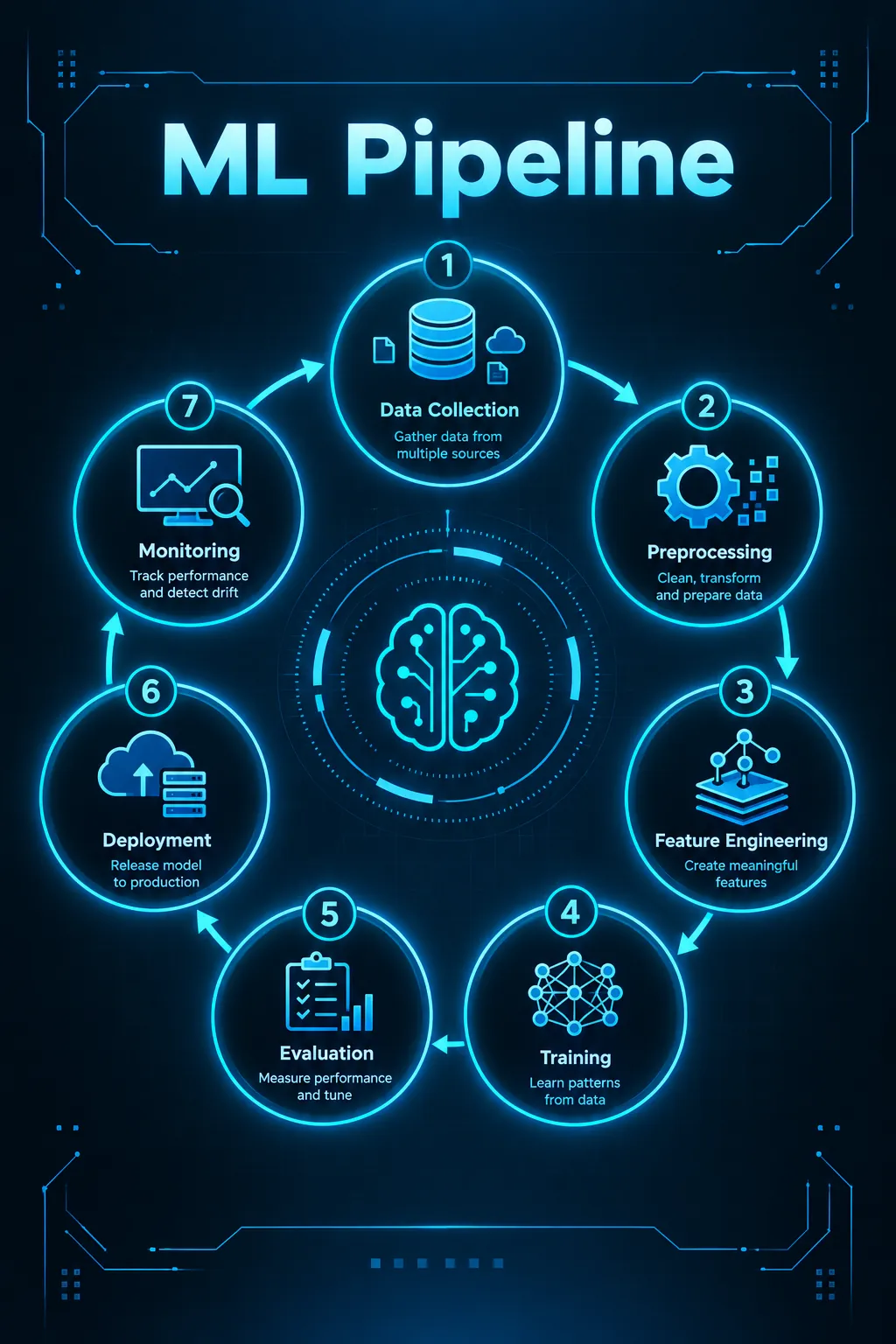
The complete ML pipeline: data collection, preprocessing, feature engineering, model training, evaluation, deployment, and MLOps monitoring.
Published
Generate a custom version of this infographic
Customize with your own data, style, and branding
Generate This InfographicProcess Steps
How Machine Learning Workflow
The machine learning workflow is a structured process that transforms raw data into production-ready predictive systems. It begins with data collection and exploration, where practitioners assess data quality, identify biases, and define problem scope. Data preprocessing accounts for 60 to 80 percent of project time and includes cleaning, normalization, handling missing values, and feature engineering to create meaningful input variables
Automated feature stores and data versioning tools are increasingly standard in mature organizations, reducing duplication and improving reproducibility across teams. Model selection depends on the problem type: classification, regression, clustering, or recommendation, with algorithms ranging from linear models to deep neural networks. Training involves splitting data into training, validation, and test sets, with cross-validation ensuring robust performance estimates
Evaluation metrics such as accuracy, precision, recall, F1 score, and AUC-ROC guide model comparison and hyperparameter tuning. Deployment moves models into production via APIs, batch pipelines, or edge devices, requiring containerization and versioning through MLOps practices. Continuous monitoring detects data drift and model degradation, triggering retraining when performance drops below thresholds
Explainability requirements in regulated industries are driving adoption of interpretable models alongside deep learning systems. Organizations with mature MLOps pipelines deploy models 5 times faster and achieve 3 times higher ROI on AI investments compared to ad hoc approaches.
Most production pain still concentrates upstream of modeling. Surveys consistently assign 60 to 80 percent of project calendar time to cleaning, labeling, deduplicating, and aligning features, because real logs mix missing codes, sensor drift, and policy changes that silently shift label meaning. Feature stores and versioned datasets reduce rework, yet domain review remains the guardrail that prevents models from learning shortcuts that fail under regulation or customer scrutiny.
Training discipline separates experiments from deployable systems. Holdout tests and k-fold cross-validation remain the dominant industrial evaluation pattern, while metrics such as precision, recall, F1, and AUC-ROC map differently to fraud, ranking, and medical triage goals. Feature engineering still lifts accuracy materially over raw columns in community benchmarks, which is why teams invest in interpretable transforms before defaulting to deeper architectures that hide failure modes.
The deployment cliff is well documented. Only about half of models reach production in many enterprise surveys, often blocked by missing monitoring, unclear ownership, or business stakeholders who never signed acceptance thresholds. Containerized APIs and batch scoring pipelines help, but without drift detection within roughly a day of shifting inputs, silent degradation erodes trust faster than a single bad release.
MLOps maturity compounds speed and return. Organizations with automated retraining, lineage, and rollback deploy about five times faster and report about three times higher ROI on AI spend than ad hoc teams, aligning with growing MLOps market projections toward tens of billions by decade end. Regulated sectors add explainability gates, pairing shallow interpretable models with deep networks where auditors require feature attributions.
A practical workflow loops backward on purpose. Monitoring triggers data audits, audits trigger feature revisions, and revisions trigger retraining rather than one-way handoffs from scientists to operators. Edge deployment extends the same loop to devices with constrained memory, demanding quantization and on-device validation before fleet rollout.
Documentation and reproducibility make the workflow auditable. Versioning datasets, code, and model artifacts together lets a team explain why a prediction changed and roll back safely when a release underperforms. Experiment tracking, model cards that describe intended use and known limitations, and clear approval gates before deployment reduce surprises later. Responsible AI practices belong in the same pipeline: bias checks across user groups, privacy reviews of training data, and human review for high-stakes decisions should be built into evaluation rather than added as an afterthought. Teams that treat the workflow as a continuous cycle instead of a one-time project ship more reliable systems and spend less time on emergency fixes.
Frequently Asked Questions
What are the main stages of a machine learning workflow?
Why does data preprocessing take so much time?
What is MLOps and why does it matter?
How do you know if an ML model is ready for production?
Sources
- Gartner AI in Production Survey, 2024
- McKinsey State of AI Report, 2024
- MarketsandMarkets MLOps Market Report, 2024
- Google Cloud AI/ML Best Practices, 2024
Source links go to each publisher's official website.
Embed This Infographic
Copy the code below to share this infographic on your website
<a href="https://www.makeinfographics.ai/infographic/machine-learning-workflow" target="_blank" rel="noopener">
  <img src="https://pic-cdn.chibistyle.app/infographics/infographics/ml-workflow.webp"
       alt="Machine Learning Workflow — The complete ML pipeline: data collection, preprocessing, feature engineering, model training, evalu"
       width="960" height="1440" loading="lazy"
       style="max-width:100%;height:auto;" />
</a>
<p>Source: <a href="https://www.makeinfographics.ai">MakeInfographics.ai</a> — Free AI Infographic Generator</p>
Create Your Own Machine Learning Workflow Infographic
Customize this topic with your own data, style, and branding
Create Custom Version — FreeMake Something for Your Own Life
Free printable planners, blank or filled in by AI from your details.


Related Infographics
All Technology & SaaS infographics →Robotic Process Automation (RPA) Statistics & Market Trends 2026
RPA market data: $22B industry valuation, 65% enterprise adoption, bot deployment stats, cost savings metrics, and leading automation use cases.
Edge Computing Infrastructure Statistics 2026
Edge computing infrastructure spending reached $92 billion in 2026, up 24%. See latency benchmarks, 5G small-cell growth, IoT scale, and key use cases.
Autonomous Vehicle Safety Statistics 2026
Self-driving car safety data, accident rates vs human drivers, sensor technology layers, regulatory milestones, and AV deployment statistics worldwide.
Blockchain Technology Explained
How blockchain works: distributed ledgers, consensus mechanisms, smart contracts, DeFi growth, and enterprise adoption across supply chain and finance.