

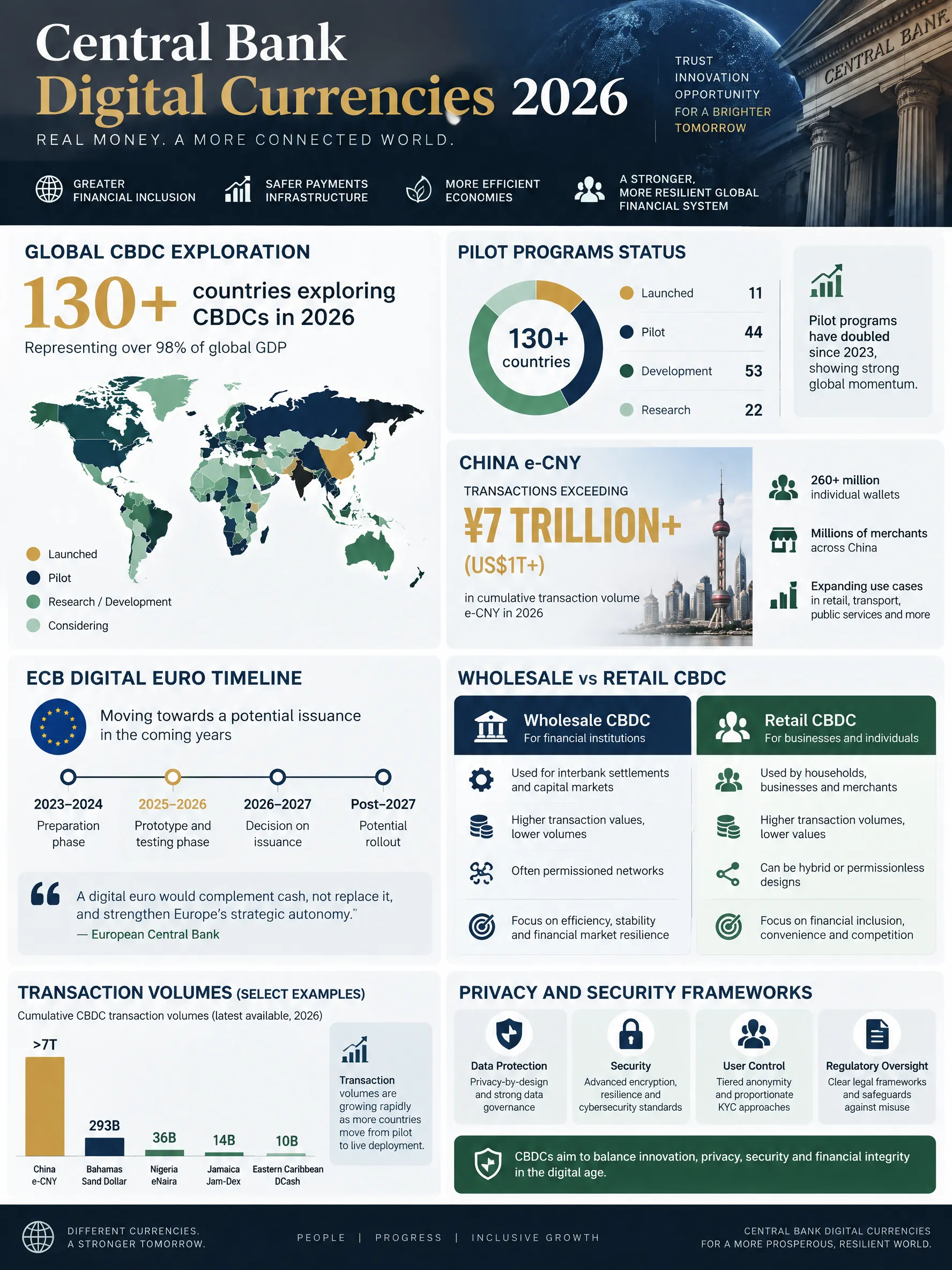
Central Bank Digital Currencies (CBDC) Statistics 2026 Infographic
CBDC adoption data for 2026: 130+ countries exploring digital currencies, China e-CNY transaction volumes, ECB digital euro progress, wholesale vs retail CBDC designs, and privacy frameworks.
Published
Generate a custom version of this infographic
Customize with your own data, style, and branding
Generate This InfographicKey Comparisons
Comparing Central Bank Digital Currencies (CBDC) Statistics 2026
Central bank digital currencies (CBDCs) represent the most significant evolution in monetary infrastructure since the transition from commodity-backed to fiat currencies. In 2026, 134 countries representing 98 percent of global GDP are actively researching, piloting, or launching CBDCs — up from 35 countries in 2020. Eleven countries have fully launched retail CBDCs, with over 36 active pilot programs worldwide.
China's digital yuan (e-CNY) remains the largest CBDC by every metric. Cumulative transaction volume has exceeded $300 billion, with 260 million individual wallets and 5.6 million merchant acceptance points. The e-CNY is integrated into major payment platforms including Alipay and WeChat Pay, and was used extensively during the 2026 Asian Games. India's digital rupee pilot has expanded to 50 cities with 15 million users, focusing on wholesale interbank settlements and retail person-to-merchant payments.
The European Central Bank's digital euro entered its preparation phase in 2025, with a planned launch in 2027-2028. The design emphasizes privacy-by-design principles with offline payment capability and holding limits of €3,000 to prevent bank disintermediation. The US Federal Reserve continues a cautious research approach without committing to a launch timeline, while the Bank of England's digital pound consultation concluded in 2025 with a decision expected by late 2026.
Wholesale CBDCs for interbank and cross-border settlements are advancing rapidly. Project mBridge, connecting central banks of China, Hong Kong, Thailand, UAE, and Saudi Arabia, has processed $22 billion in cross-border transactions, reducing settlement time from 3-5 days to seconds. The Bank for International Settlements estimates that wholesale CBDCs could save the global financial system $100 billion annually in cross-border transaction costs. Privacy and surveillance concerns remain the primary public objection, with most CBDC designs implementing tiered privacy — small transactions are anonymous, while larger transactions require identity verification for anti-money-laundering compliance.
Frequently Asked Questions
What is a CBDC and how is it different from cryptocurrency?
Which country is leading in CBDC development?
Do CBDCs pose privacy risks?
Sources
- Atlantic Council, Central Bank Digital Currency Tracker, 2026
- People's Bank of China, Digital Currency Report, 2026
- Bank for International Settlements, CBDC Survey and Innovation Hub Reports, 2026
- European Central Bank, Digital Euro Preparation Phase Report, 2026
- Reserve Bank of India, Digital Rupee Pilot Progress Report, 2026
Source links go to each publisher's official website.
Embed This Infographic
Copy the code below to share this infographic on your website
<a href="https://www.makeinfographics.ai/infographic/central-bank-digital-currency-cbdc-statistics-2026" target="_blank" rel="noopener">
  <img src="https://www.makeinfographics.ai/images/infographics/cbdc-digital-currency.webp"
       alt="Central Bank Digital Currencies (CBDC) Statistics 2026 — CBDC adoption data for 2026: 130+ countries exploring digital currencies, China e-CNY transaction vo"
       width="960" height="1280" loading="lazy"
       style="max-width:100%;height:auto;" />
</a>
<p>Source: <a href="https://www.makeinfographics.ai">MakeInfographics.ai</a> — Free AI Infographic Generator</p>
Create Your Own Central Bank Digital Currencies (CBDC) Statistics 2026 Infographic
Customize this topic with your own data, style, and branding
Create Custom Version — FreeRelated Infographics
All Finance & FinTech infographics →Startup Funding Stages Explained
Startup funding from pre-seed to IPO: typical round sizes, valuations, investor types, dilution rates, and what founders need at each stage.
Personal Finance Budget Planning Checklist
A comprehensive checklist for personal finance budget planning, covering the 50/30/20 rule, expense tracking, emergency funds, debt management, and savings strategies backed by 2025–2026 household spending data.
Cryptocurrency Regulation: Global Landscape 2026
Comprehensive comparison of cryptocurrency regulatory frameworks across major jurisdictions, covering DeFi rules, stablecoin legislation, tax treatment, and enforcement actions.
Global FinTech Adoption Trends 2026
Process overview of fintech adoption worldwide covering digital payments, mobile banking, neobanks, BNPL services, open banking, and embedded finance market growth.