

Supply Chain Management Overview Infographic
Modern supply chain management: procurement, logistics, inventory optimization, digital twin technology, and resilience strategies for 2026.
Published
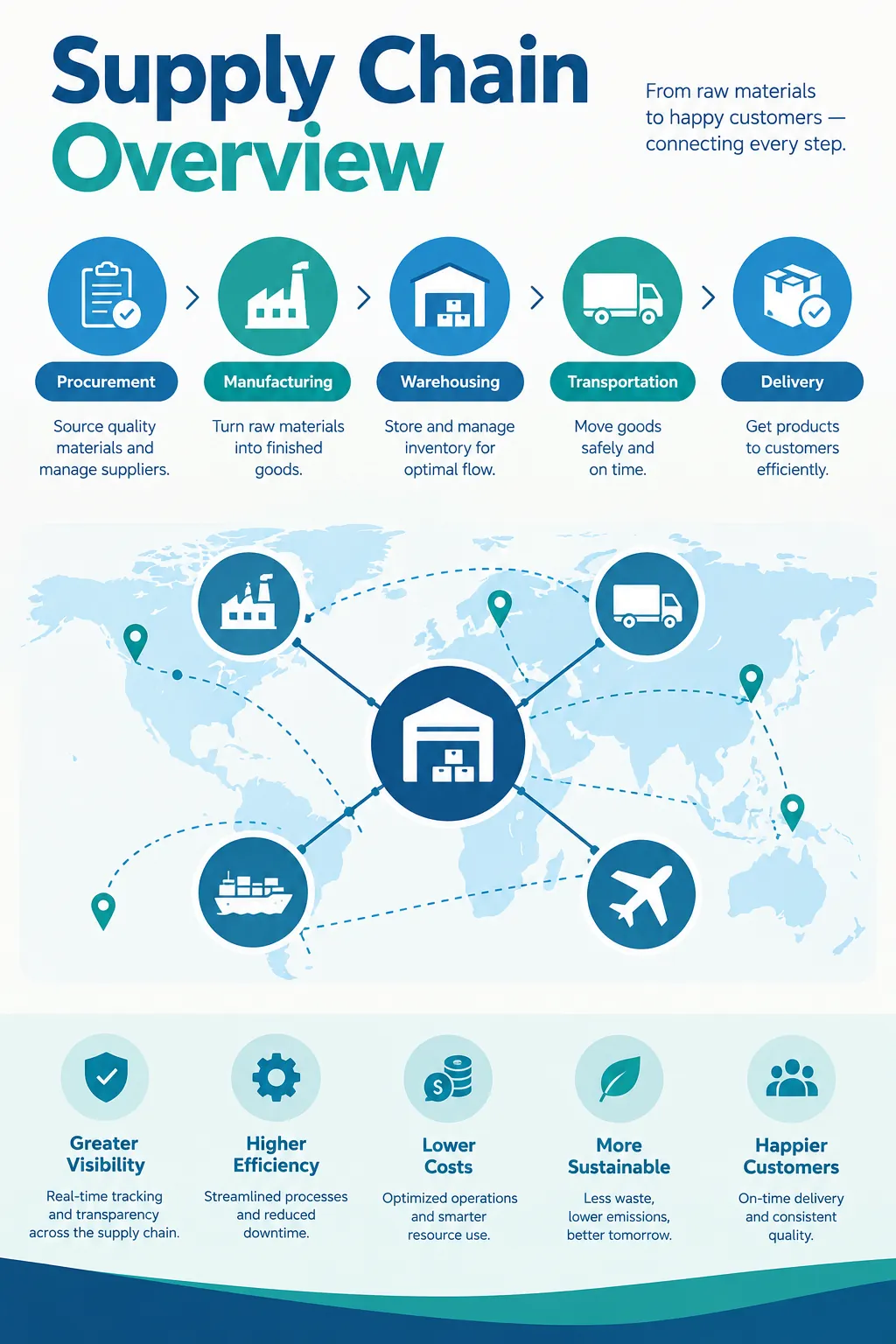
Generate a custom version of this infographic
Customize with your own data, style, and branding
Generate This InfographicProcess Steps
How Supply Chain Management Overview
Supply chain management coordinates the flow of goods, information, and finances from raw material suppliers to end customers, forming the backbone of global commerce. The industry manages over $25 trillion in global trade annually, with disruptions costing the average company 45 percent of one year's profits over a decade according to McKinsey research. Modern SCM encompasses procurement, manufacturing, warehousing, transportation, and last-mile delivery, each stage offering optimization opportunities through technology and data analytics
Nearshoring and friend-shoring trends are reshaping supplier networks as companies reduce dependence on single geographic regions exposed to geopolitical risk. Inventory management alone can reduce carrying costs by 20 to 30 percent through demand forecasting and just-in-time practices. Digital transformation including IoT sensors, AI demand forecasting, and blockchain traceability is reshaping visibility across multi-tier supplier networks
The COVID-19 pandemic exposed vulnerabilities in single-source dependencies, driving a shift toward regionalization and supplier diversification. E-commerce fulfillment expectations of same-day or next-day delivery have compressed delivery timelines, requiring automated warehouses and optimized route planning. Warehouse automation adoption grew 35 percent year-over-year as retailers invest in fulfillment speed
Real-time visibility platforms reduce stockout incidents by up to 30 percent in retail supply chains. Companies investing in supply chain resilience report 30 percent faster recovery from disruptions and measurably higher customer satisfaction scores.
Planning and sourcing set the ceiling for everything downstream. When demand signals arrive late, factories expedite freight, warehouses hold safety stock, and margins erode simultaneously. McKinsey’s finding that disruptions can erase nearly half of a decade’s profits for a typical firm explains why boards now treat resilience as a balance-sheet issue, not only an operations metric. Multi-tier visibility remains weak in many industries because suppliers hesitate to share capacity data, yet without it buyers rediscover single-source risk only after a port closure or factory shutdown.
Procurement teams increasingly score suppliers on geographic diversity and financial health, not only unit price. World Trade Organization-scale flows exceeding $25 trillion in annual trade mean even small percentage delays ripple through assembly plants and retail shelves within weeks. Chief procurement officers surveyed by Deloitte report double-digit inventory savings when forecasting models ingest point-of-sale and weather data instead of last-year spreadsheets alone, freeing cash for supplier diversification projects.
Manufacturing and logistics stages compress as e-commerce promises next-day or same-day delivery. Last-mile spend often exceeds half of total shipping cost, pushing networks toward urban micro-fulfillment and automated sortation. Warehouse automation adoption rising sharply year over year reflects that pressure. Nearshoring and friend-shoring relocate some production closer to demand, trading labor arbitrage for shorter transits and clearer regulatory environments, though not every category can reshore without price shocks.
Inventory optimization is where analytics pay fastest. AI-driven forecasting that trims carrying costs by 20 to 30 percent frees working capital while reducing obsolescence on fashion and electronics SKUs. Just-in-time practices still fail when shocks are correlated globally, which is why diversified suppliers and regional buffers re-entered strategy playbooks after pandemic-era shortages. Companies with diversified bases recover from disruptions roughly 30 percent faster according to BCG-cited benchmarks, a tangible service-level advantage customers notice.
Returns management closes the loop for online retail and increasingly for B2B spare parts. Reverse logistics can consume double the labor of forward picking if processes are ad hoc. Digital twins let teams simulate lane closures or supplier delays before committing capital, pairing with IoT tracking that grew adoption by a quarter in a single year per Gartner surveys. Through 2027, expect tighter links between payment data, shipment telemetry, and carbon accounting as regulators and large buyers demand traceability alongside cost.
Resilience investments now compete with efficiency targets in board discussions: dual sourcing, regional buffer stocks, and supplier-visibility tools cost money in good years but shorten recovery time when shocks hit.
Frequently Asked Questions
What are the key stages of supply chain management?
How is technology transforming supply chains?
Why is supply chain resilience important?
What is the impact of e-commerce on supply chains?
Sources
- World Trade Organization (WTO) Trade Statistics, 2024
- McKinsey Global Supply Chain Report, 2024
- Gartner Supply Chain Technology Survey, 2024
- Deloitte Global Chief Procurement Officer Survey, 2024
Source links go to each publisher's official website.
Embed This Infographic
Copy the code below to share this infographic on your website
<a href="https://www.makeinfographics.ai/infographic/supply-chain-management" target="_blank" rel="noopener">
  <img src="https://pic-cdn.chibistyle.app/infographics/infographics/supply-chain.webp"
       alt="Supply Chain Management Overview — Modern supply chain management: procurement, logistics, inventory optimization, digital twin technol"
       width="960" height="1440" loading="lazy"
       style="max-width:100%;height:auto;" />
</a>
<p>Source: <a href="https://www.makeinfographics.ai">MakeInfographics.ai</a> — Free AI Infographic Generator</p>
Create Your Own Supply Chain Management Overview Infographic
Customize this topic with your own data, style, and branding
Create Custom Version — FreeMake Something for Your Own Life
Free printable planners, blank or filled in by AI from your details.

Related Infographics
All E-Commerce infographics →E-Commerce Returns & Reverse Logistics Statistics 2026
Returns data: $820B annual return volume, return rates by category, environmental impact, reverse logistics costs, and restocking technology trends.
Cross-Border E-Commerce Logistics 2026
Cross-border e-commerce hit $1.6T in 2026 (22% of online sales): customs stages, de minimis limits, DDP vs DAP, and AI HS codes.
Subscription Economy Business Model Statistics 2026
The subscription economy reached $330 billion in 2026 with 18% CAGR. Retention benchmarks, SaaS vs physical models, and signals of consumer fatigue.
History of E-Commerce: Online Shopping Milestones Timeline
E-commerce history timeline from the first secure 1994 online sale to Q2 2026, when U.S. retail e-commerce reached 17.1% of total sales (Census Bureau).