

Quick Commerce & Grocery Delivery Guide 2026 Infographic
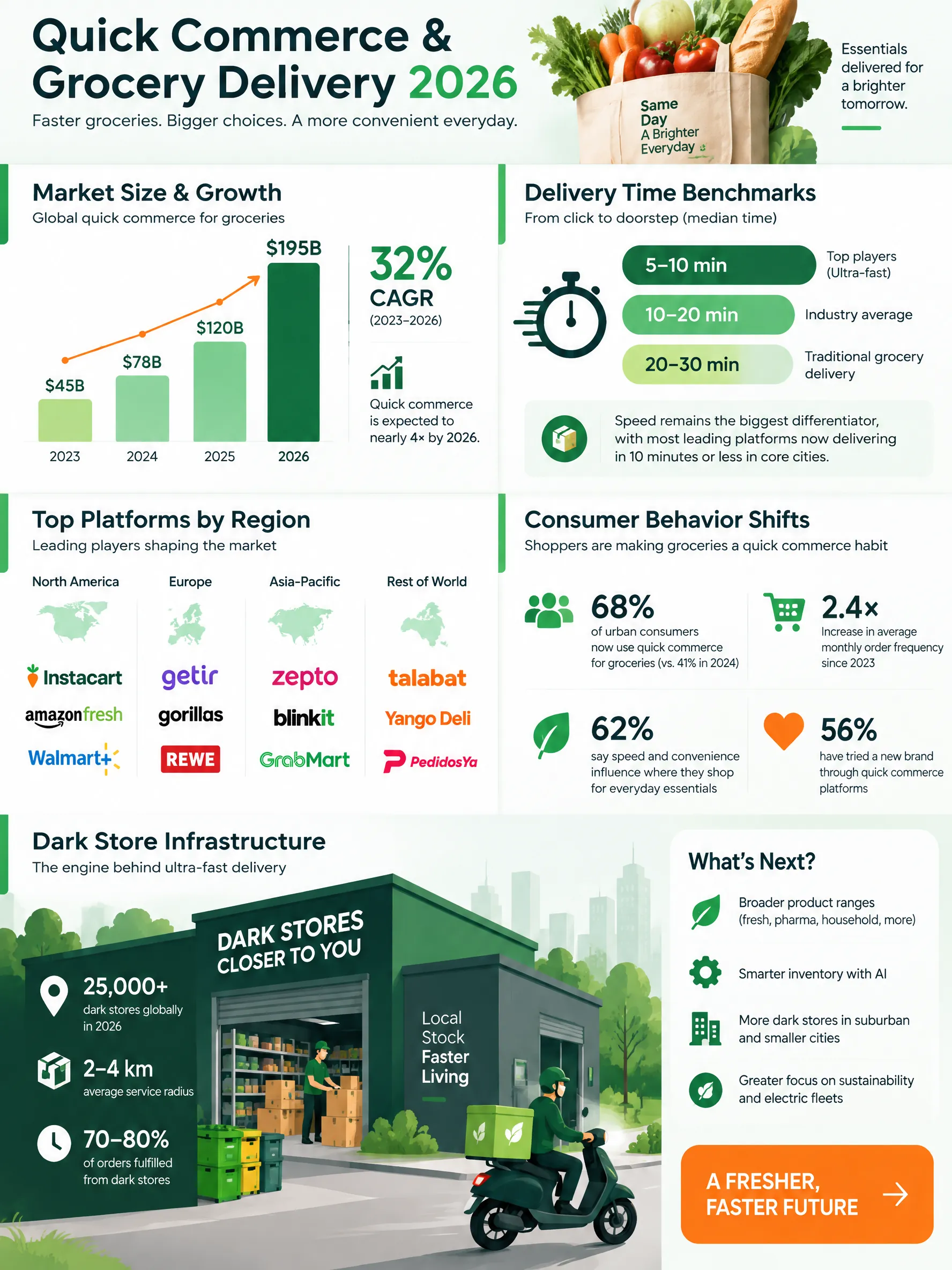
Quick commerce market size, delivery time benchmarks, dark store infrastructure, top platforms by region, consumer adoption trends, and unit economics data.
Published
Generate a custom version of this infographic
Customize with your own data, style, and branding
Generate This InfographicKey Insights
- 1Global quick commerce market reached $150 billion in 2026 (Euromonitor, 2026)
- 2India's q-commerce sector reached $10 billion with 10-15 minute delivery standard (RedSeer, 2026)
- 3Approximately 25,000 dark stores operate globally across all q-commerce platforms (McKinsey, 2026)
- 4Average q-commerce order value: $18-25 with 2.8 weekly orders among active users (Bain & Company, 2026)
- 5Subscription models boost 30-day customer retention from 35% to 72% (Apptopia, 2026)
- 6Autonomous delivery robots and drones projected to reduce delivery costs by 40-60% (McKinsey, 2026)
- 7Meituan and Ele.me serve 450 million combined users in China's instant delivery market (iResearch, 2026)
Guide to Quick Commerce & Grocery Delivery Guide 2026
Quick commerce (q-commerce) — the delivery of everyday essentials in under 30 minutes — has matured from a pandemic-era experiment into a $150 billion global industry in 2026. What began with grocery delivery has expanded to include pharmaceuticals, convenience items, beauty products, electronics accessories, and even pet supplies, fundamentally reshaping how urban consumers access daily necessities.
The global q-commerce landscape varies significantly by region. In China, Meituan Instashopping and Ele.me dominate with 15-minute delivery in tier-1 cities, serving 450 million users combined. India's quick commerce sector exploded to $10 billion, led by Blinkit (Zomato), Zepto, and Swiggy Instamart — all delivering in 10-15 minutes in major metros. In Europe, Getir (Turkey-born, pan-European), Gorillas (acquired by Getir), and Flink compete in Western European cities, though consolidation reduced the number of players from 15 in 2021 to 5 by 2026. The US market is led by Instacart, DoorDash DashMart, and Uber's delivery vertical, with GoPuff maintaining its convenience-store delivery niche. Middle Eastern markets see Noon Minutes and Talabat Mart growing at 40% annually.
Dark stores — micro-fulfillment centers positioned in residential areas — are the infrastructure backbone of q-commerce. A typical dark store operates from a 2,000-4,000 sq ft space, stocks 2,000-5,000 SKUs, fulfills 300-500 orders daily, and requires a 1.5-3 km delivery radius to maintain sub-30-minute delivery. By 2026, an estimated 25,000 dark stores operate globally. The economics have improved but remain challenging: average order value is $18-25, gross margins range 20-28% on groceries, and rider delivery cost per order is $2.50-4.00. Companies achieving profitability do so through advertising revenue ($1-2 per order from brand-sponsored placements), private label products (30-40% higher margins), subscription models (30% of orders from subscribers who order 3-4x weekly), and order density optimization (8+ orders per rider per hour in mature zones).
Consumer behavior data reveals clear patterns. The core q-commerce user is 25-40 years old, urban, dual-income, and values time over price — willing to pay 10-15% premiums for speed. Average weekly order frequency among active users is 2.8 times. Top-ordered categories: fresh produce and dairy (28%), beverages (18%), snacks (15%), household essentials (14%), personal care (10%), and ready-to-eat meals (8%). Peak ordering hours are 6-9 PM (dinner preparation) and 10 AM-12 PM (weekend replenishment). Rainy and extreme weather days see 40-60% order spikes. Customer retention after first order averages 35% at 30 days, with subscription plans boosting this to 72%.
The future of q-commerce points toward consolidation, profitability, and technology integration. Autonomous delivery robots (deployed by Starship Technologies in 20+ cities) and drone delivery (approved for commercial operation in select US and UAE markets) will reduce the $2.50-4.00 per-order delivery cost by 40-60%. AI-powered demand prediction reduces food waste by 25% and stockout rates by 35%. Vertical integration into private-label manufacturing gives platforms 40% higher margins. The convergence of q-commerce with traditional grocery retail is accelerating — major retailers (Walmart, Carrefour, Tesco) now operate their own rapid-delivery services from existing stores, combining established supply chains with last-mile speed.
Frequently Asked Questions
How does quick commerce achieve 10-30 minute delivery?
Is quick commerce profitable?
Will quick commerce replace traditional grocery shopping?
Sources
- Euromonitor International, Quick Commerce Global Market Report, 2026
- RedSeer Consulting, India Quick Commerce Report, 2026
- McKinsey & Company, The Future of Last-Mile Delivery, 2026
- Bain & Company, Quick Commerce Consumer Behavior Study, 2026
- iResearch, China Instant Retail Market Report, 2026
Source links go to each publisher's official website.
Embed This Infographic
Copy the code below to share this infographic on your website
<a href="https://www.makeinfographics.ai/infographic/quick-commerce-grocery-delivery-statistics-2026" target="_blank" rel="noopener">
  <img src="https://www.makeinfographics.ai/images/infographics/quick-commerce-grocery.webp"
       alt="Quick Commerce & Grocery Delivery Guide 2026 — Quick commerce market size, delivery time benchmarks, dark store infrastructure, top platforms by re"
       width="960" height="1280" loading="lazy"
       style="max-width:100%;height:auto;" />
</a>
<p>Source: <a href="https://www.makeinfographics.ai">MakeInfographics.ai</a> — Free AI Infographic Generator</p>
Create Your Own Quick Commerce & Grocery Delivery Guide 2026 Infographic
Customize this topic with your own data, style, and branding
Create Custom Version — FreeRelated Infographics
All E-Commerce infographics →Supply Chain Management Overview
Modern supply chain management: procurement, logistics, inventory optimization, digital twin technology, and resilience strategies for 2026.
Digital Payment Methods: A Complete Guide for E-Commerce in 2026
Explore the leading digital payment methods transforming e-commerce in 2026 — from mobile wallets and BNPL to cryptocurrency and real-time payments — with adoption data and implementation tips.
DTC E-Commerce Brand Trends 2026
Timeline of direct-to-consumer brand evolution from 2010 to 2026, covering market growth, customer acquisition shifts, social commerce, subscription models, and fulfillment innovation.
Global Pet Care Industry Statistics 2026
Complete overview of the $350 billion global pet care market covering ownership rates, spending categories, pet health trends, and emerging pet-tech innovations.