

Nuclear Fusion Energy: How It Works & Where It Stands Infographic
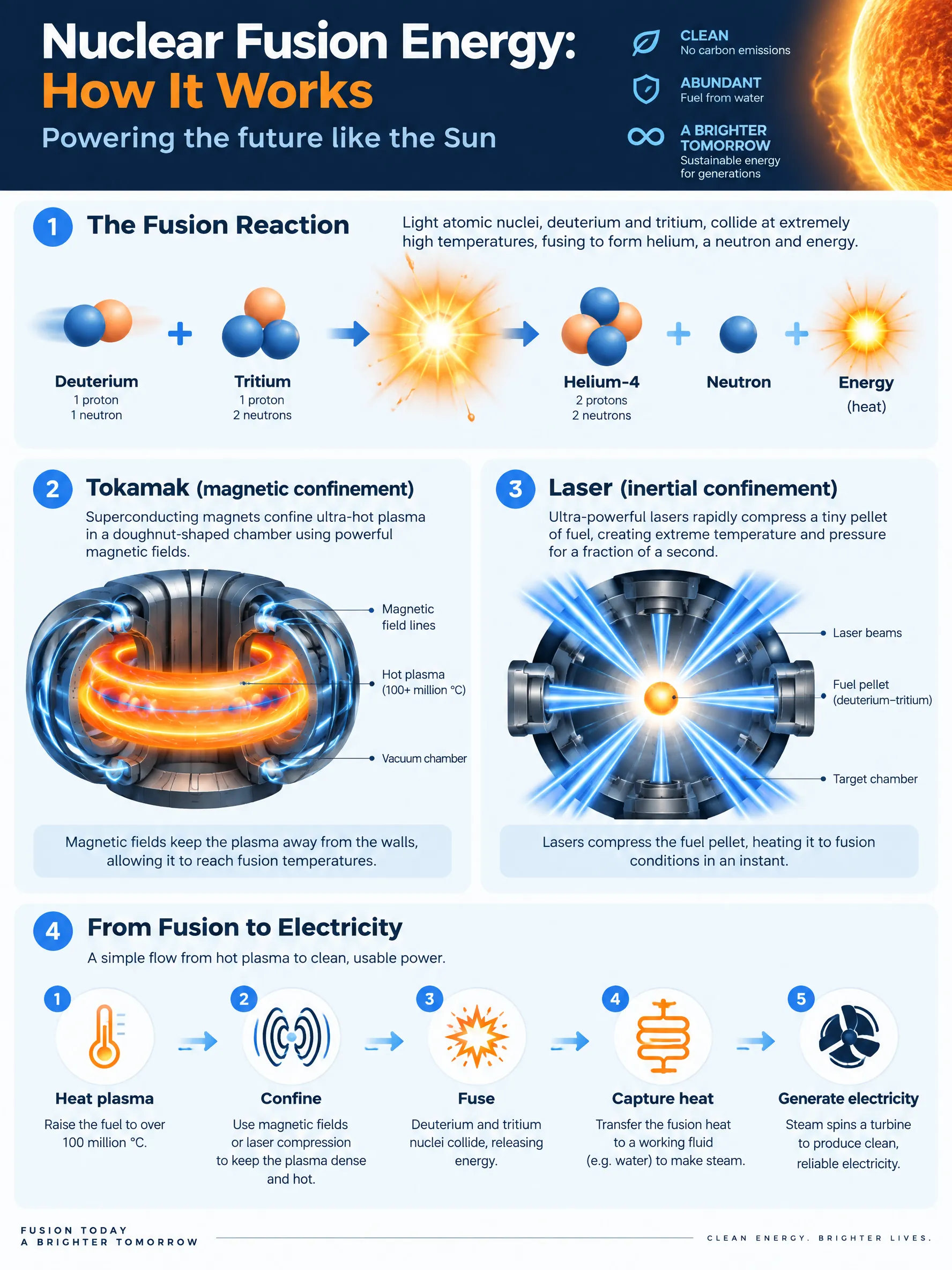
How nuclear fusion works, from deuterium-tritium reactions to tokamaks and lasers, plus milestones from NIF ignition, JET, and the ITER project.
Published
Generate a custom version of this infographic
Customize with your own data, style, and branding
Generate This InfographicProcess Steps
How Nuclear Fusion Energy: How It Works & Where It Stands
Nuclear fusion is the process that powers the Sun: light atomic nuclei combine into a heavier one and release energy because the product has slightly less mass than the parts. On Earth, the most practical reaction fuses two hydrogen isotopes, deuterium and tritium, into helium-4 and a high-energy neutron. Deuterium is abundant in seawater, while tritium is scarce and is expected to be bred inside the reactor from lithium. Fusion produces no carbon dioxide during operation, and unlike fission it cannot sustain a runaway chain reaction, which is why it attracts sustained research funding even though commercial power remains years away.
The central challenge is conditions. To overcome the electrical repulsion between nuclei, the fuel must be heated until it becomes plasma, an ionized gas at roughly 150 million degrees Celsius according to the ITER project, hotter than the core of the Sun. No material wall can touch plasma at that temperature, so scientists use two main approaches to confine it long enough for fusion reactions to occur at useful rates.
Magnetic confinement uses powerful superconducting magnets to hold plasma in a ring-shaped vessel. The tokamak, a Russian design, is the most developed version, and stellarators use more complex twisted magnets for steadier operation. Inertial confinement takes the opposite approach: powerful lasers or other drivers compress a tiny fuel capsule so quickly that fusion occurs before the capsule can fly apart. Each path has distinct engineering problems. Magnetic devices must sustain plasma for long periods, while inertial systems must repeat tiny explosions many times per second to make a power plant.
Recent milestones show that the physics works. In December 2022, the National Ignition Facility at Lawrence Livermore National Laboratory delivered 2.05 megajoules of laser energy to a fuel capsule and produced 3.15 megajoules of fusion energy, the first time a lab experiment released more fusion energy than the laser energy that reached the target. In the magnetic approach, the Joint European Torus, operated by the UK Atomic Energy Authority, set a record in its final experiments by producing 69 megajoules of fusion energy over about five seconds from only 0.2 milligrams of fuel.
The next large step is ITER, the international tokamak under construction in southern France, backed by seven Members: China, the European Union, India, Japan, Korea, Russia, and the United States. Its goal is to produce 500 megawatts of fusion power from 50 megawatts of heating power, a tenfold gain. Following a revised baseline announced in 2024, ITER plans to begin research operation in 2034 and deuterium-tritium operation in 2039. ITER will not generate electricity, but it is designed to prove that a burning plasma can be controlled at power-plant scale and to test components such as tritium-breeding blanket modules.
It is important to separate scientific gain from engineering gain. NIF's result counts energy leaving the target against laser energy reaching it, but the facility's lasers drew far more electricity from the grid than the fusion energy produced. A commercial power plant needs a gain high enough to cover all of its own power use and still deliver surplus electricity, along with materials that survive neutron bombardment and fuel cycles that make tritium reliably. Those are engineering and cost challenges, not just physics questions.
For readers following the field, a few signals matter more than headlines: sustained plasma duration, energy gain measured against total plant power, materials test results, and the construction progress of public and private machines. Timelines have slipped before, so cautious optimism is more useful than hype. The process diagram in this infographic shows the full chain from heating plasma to generating electricity, which makes it easier to see which links of the chain are proven and which remain open problems.
Frequently Asked Questions
How does nuclear fusion work?
What is the difference between a tokamak and laser fusion?
Did scientists achieve net energy from fusion?
When will fusion power plants be available?
Is fusion safer than fission?
Sources
- Lawrence Livermore National Laboratory, National Ignition Facility Results, 2022
- UKAEA, JET Final Fusion Energy Record, 2024
- ITER Organization, ITER Baseline and Project Overview, 2024
Source links go to each publisher's official website.
Embed This Infographic
Copy the code below to share this infographic on your website
<a href="https://www.makeinfographics.ai/infographic/nuclear-fusion-energy-how-it-works-2026" target="_blank" rel="noopener">
  <img src="https://pic-cdn.chibistyle.app/infographics/infographics/nuclear-fusion-energy-2026.webp"
       alt="Nuclear Fusion Energy: How It Works & Where It Stands — How nuclear fusion works, from deuterium-tritium reactions to tokamaks and lasers, plus milestones f"
       width="960" height="1280" loading="lazy"
       style="max-width:100%;height:auto;" />
</a>
<p>Source: <a href="https://www.makeinfographics.ai">MakeInfographics.ai</a> — Free AI Infographic Generator</p>
Create Your Own Nuclear Fusion Energy: How It Works & Where It Stands Infographic
Customize this topic with your own data, style, and branding
Create Custom Version — FreeRelated Infographics
All Science & Nature infographics →Renewable Hydrogen Energy Production Process
Green hydrogen costs $3.50–$5.50/kg in 2026 with 45 GW dedicated renewable capacity—electrolysis, storage, transport, and industrial end uses.
Dark Matter & Dark Energy Guide 2026
About 95% of the universe is dark energy and dark matter; see 2026 detection methods, DESI, JWST, Rubin LSST, and particle candidates.
Coral Reef Ecosystem Decline Timeline & Conservation Data 2026
Coral reef decline data: 50% lost since 1950, mass bleaching events timeline, ocean acidification impact, restoration costs, and marine biodiversity loss.
Quantum Biology Discoveries & Research Guide 2026
Quantum biology in 2026: >95% photosynthetic transfer efficiency, robin cryptochrome compasses, enzyme tunneling, and $180M global research funding.