

Dark Matter & Dark Energy Guide 2026 Infographic
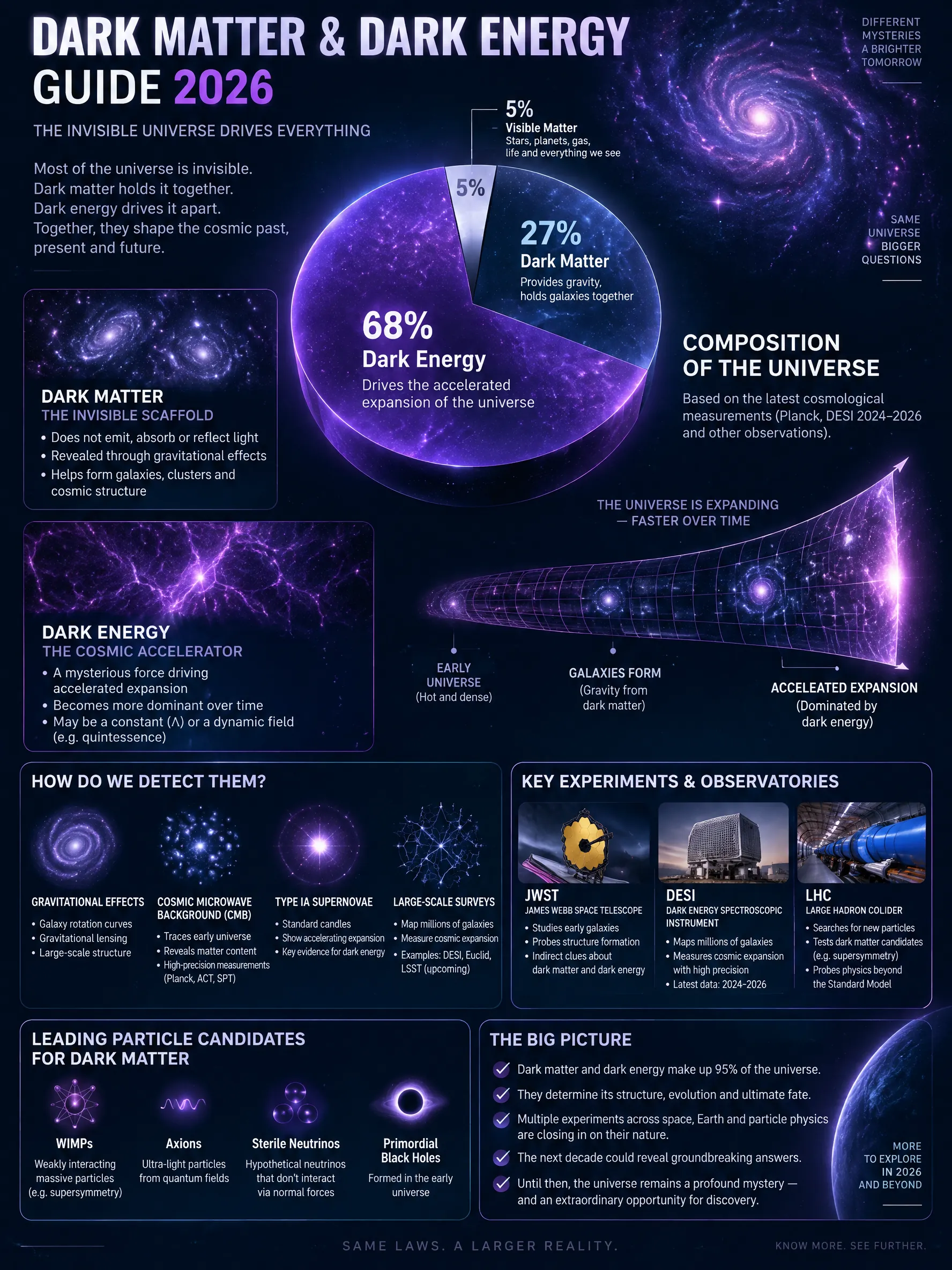
Universe composition data, dark matter detection methods, dark energy evidence, key experiments (JWST, DESI, LHC), particle candidates, and cosmological mysteries.
Published
Generate a custom version of this infographic
Customize with your own data, style, and branding
Generate This InfographicKey Insights
- 1Universe composition: 68% dark energy, 27% dark matter, 5% ordinary matter (Planck Collaboration, 2025)
- 2Dark matter mass in observable universe: approximately 2.4 × 10^53 kg, 6x all ordinary matter (Planck, 2025)
- 3DESI surveyed 40 million galaxies and found hints dark energy density may change over time (DESI Collaboration, 2024)
- 4XENONnT reached sensitivity of 10^-47 cm² without WIMP detection, challenging leading models (XENON Collaboration, 2025)
- 5Vera Rubin Observatory LSST catalogs 18 billion galaxies for dark matter mapping via weak lensing (Rubin Observatory, 2026)
- 6The cosmological constant problem: quantum theory predicts vacuum energy 10^120 times larger than observed (Reviews of Modern Physics, 2025)
- 7JWST discovered unexpectedly massive early galaxies challenging dark matter structure formation models (Nature Astronomy, 2025)
Guide to Dark Matter & Dark Energy Guide 2026
The universe harbors a profound mystery: 95% of its total mass-energy content remains invisible and poorly understood. Dark matter comprises approximately 27% and dark energy approximately 68% of the universe, while all ordinary matter — every star, planet, person, and atom we can detect — accounts for merely 5%. In 2026, a new generation of experiments and observatories is pushing the boundaries of our understanding of these cosmic unknowns.
Dark matter is inferred from its gravitational effects rather than direct observation. The evidence is overwhelming and multi-layered: galaxy rotation curves (stars at the edges of galaxies orbit faster than visible mass alone would predict, first observed by Vera Rubin in the 1970s), gravitational lensing (massive dark matter concentrations bend light from background galaxies, as spectacularly captured by JWST), the cosmic microwave background (CMB temperature fluctuations measured by Planck satellite match models requiring dark matter), and large-scale structure formation (computer simulations of the universe only reproduce observed galaxy distributions when dark matter is included). The total mass of dark matter in the observable universe is estimated at 2.4 × 10^53 kg — approximately six times the mass of all ordinary matter.
The leading dark matter particle candidates span a wide mass range. WIMPs (Weakly Interacting Massive Particles, mass 10-1000 GeV) were the frontrunner for decades but have eluded increasingly sensitive detectors — the XENONnT experiment in Italy achieved a sensitivity of 10^-47 cm² cross-section without a detection, pushing WIMP models to their theoretical limits. Axions (mass 10^-6 to 10^-3 eV) are gaining momentum as candidates: the ADMX experiment reached unprecedented sensitivity in the 2-4 GHz frequency range, and new broadband approaches could scan the full predicted mass range within a decade. Sterile neutrinos (mass 1-100 keV) could explain both dark matter and neutrino mass anomalies, with X-ray telescopes searching for their decay signatures. Primordial black holes — black holes formed in the early universe rather than from stellar collapse — have re-emerged as viable candidates, particularly in the asteroid-mass range (10^17-10^23 kg), where gravitational microlensing surveys are setting new constraints.
Dark energy is even more enigmatic. Discovered in 1998 through observations that the universe's expansion is accelerating (Nobel Prize 2011 to Perlmutter, Schmidt, and Riess), dark energy acts as a repulsive force on cosmic scales. The simplest explanation is Einstein's cosmological constant (Λ) — a fixed energy density of empty space equal to approximately 6 × 10^-10 joules per cubic meter. However, quantum field theory predicts a vacuum energy 10^120 times larger than observed, creating what physicists call 'the worst prediction in physics.' The Dark Energy Spectroscopic Instrument (DESI), which completed its initial survey of 40 million galaxies in 2024, has provided hints that dark energy density may be changing over time — a result that, if confirmed, would rule out the cosmological constant and point toward dynamic 'quintessence' models.
The experimental frontier in 2026 is rich with next-generation projects. The Vera C. Rubin Observatory's Legacy Survey of Space and Time (LSST) began operations, mapping the distribution of dark matter across 18 billion galaxies through weak gravitational lensing. The European Space Agency's Euclid mission is producing 3D maps of the dark universe across 10 billion years of cosmic history. JWST continues to reveal high-redshift galaxies that challenge existing dark matter models — some galaxies appear too massive too early, requiring revisions to structure formation theories. The LHC's Run 3 searches for dark matter particles produced in high-energy collisions, while underground experiments like LZ (LUX-ZEPLIN), PandaX-4T, and DARWIN push direct detection sensitivity to unprecedented levels.
Frequently Asked Questions
What is dark matter and how do we know it exists?
What is dark energy and why is the universe accelerating?
Will we ever detect dark matter particles?
Sources
- Planck Collaboration, Cosmological Parameters Results, 2025
- DESI Collaboration, Baryon Acoustic Oscillation Measurements, 2024
- XENON Collaboration, First Dark Matter Search Results from XENONnT, 2025
- Vera C. Rubin Observatory, LSST Survey Design, 2026
- Nature Astronomy, JWST Early Galaxy Observations, 2025
Source links go to each publisher's official website.
Embed This Infographic
Copy the code below to share this infographic on your website
<a href="https://www.makeinfographics.ai/infographic/dark-matter-dark-energy-universe-guide-2026" target="_blank" rel="noopener">
  <img src="https://www.makeinfographics.ai/images/infographics/dark-matter-dark-energy.webp"
       alt="Dark Matter & Dark Energy Guide 2026 — Universe composition data, dark matter detection methods, dark energy evidence, key experiments (JWS"
       width="960" height="1280" loading="lazy"
       style="max-width:100%;height:auto;" />
</a>
<p>Source: <a href="https://www.makeinfographics.ai">MakeInfographics.ai</a> — Free AI Infographic Generator</p>
Create Your Own Dark Matter & Dark Energy Guide 2026 Infographic
Customize this topic with your own data, style, and branding
Create Custom Version — FreeRelated Infographics
All Science & Nature infographics →The Solar System: Planets at Scale
A visual guide to our solar system — compare planet sizes, distances, temperatures, and key facts from Mercury to Neptune. Includes fascinating data on moons, rings, and extreme conditions.
Deep Ocean Zones and Marine Life
Dive into the five layers of the ocean — from the sunlit surface to the crushing depths of the hadal zone at 11,000 meters. Discover the unique creatures, extreme conditions, and mysteries of each depth layer.
CRISPR Gene Editing Breakthroughs & Applications 2026
Timeline of CRISPR milestones from discovery to approved therapies, covering clinical trials, agricultural applications, ethical debates, and the gene editing market outlook.
Space Debris & Orbital Pollution Data 2026
Comparative analysis of space debris by orbit type, generation sources, growth projections, cleanup technologies, and collision risk assessments for the space sustainability crisis.